Dead or Undead – Week 22 of the 52 week short story challenge

3845454_orig

Another list.

A shorter one but one which tugged at her heart strings.

You blame FaceAche of course. In the days before social media people would tell each other how they felt – face to face, or on the phone – but people thought about what they were saying – usually.

Social media made it all so simple.

Snappy, ill-thought out comments typed on a computer, a tablet or a phone.

Press the send button and move on.

Blame it on auto correct or a typo if people take offence.

Shrug it off if you don’t care.

Time and experience had led you to an understanding of depression and unhappiness. You empathise with those who felt the pain and were in awe of those who fought against their demons on a daily basis.

Some survived the sadness.

Some didn’t, and she mourned the loss of them and that they could see no light at the end of the tunnel.

Then there were the people on the list.

People you knew and cared for.

People who you had listened to and did your best to support.

People whose unhappiness was rooted in the past, long before you knew them or was in a position to have any impact on their lives.

So why were they laying the blame at your door now?

Sitting on your shoulders, the pensive and impulsive angels watch as you scan the list.

‘Get rid of them.’ said Impulsive. ‘You don’t need people like that in your life. It’s only social media and if you block and unfriend them you can’t see what they have to say about you anyway.”

‘So sad.’ said Pensive. ‘These are people that you care about. Why do you want them out of your life?’

Does someone care about you when they send you hateful messages because you won’t do as you’re told?

Surely if people care about you they will accept you as you are – regardless of your political beliefs or whether you choose not to like the people that they like?

‘Be yourself.’ said Impulsive. ‘You don’t need people like that. They’ll sap your energies and make you feel guilty for things that aren’t your fault. Surely you should be allowed to choose your own friends and hold your own opinions without being told that you have to change to make other people happy.’

‘Yes.’ said Pensive. ‘But these are people who have been supportive to you. Friends who you trusted. Do you really want them out of your life. Do you want them to disappear?’

If they are going to blame you for their unhappiness, then yes.

Spotting phonies and parasites has always been so easy – except that spotting them long before anyone else does can cause issues. You find yourself wary and unable to trust them when everyone else is singing their praises.

Then the person concerned realises that you have seen through their facade; that you pose a risk to their life and slowly, they begin to spread the poison about you whilst proving themselves to be such a good and valuable friend to everyone.

‘I know the type.’ said Impulsive. ‘If your other friends are so blind then they can’t be worth much anyway.’

‘But they are.’ said Pensive. ‘It isn’t their fault that they are more trusting and gullible than you are. It isn’t a reason to cut them out of your life is it?’

In some cases, yes. The constant nagging to get you to change your mind wears you down. The pleading on behalf of a person who took money from you, told lies about you and put you in this unhappy situation. The hateful messages blaming you for everything that has ever gone wrong. You want them gone. You want them dead to you.

Pensive sighed, as was her way. Impulsive grinned, knowing that she had won this particular battle. They watched as the pen scratched through the first three names on the list.

‘What about these two?’ said Pensive. ‘What makes them different from the others?’

‘If they are making you unhappy, strike them off too.’ said Impulsive.

These are harder to get rid of. These two are people whose demons tell them that anyone who doesn’t think the same as them is against them. These two are people who either cut you out of their life, or who are not content to let you have your own beliefs and be true to yourself.

Before social media it didn’t matter.

Before social media you could think what you wanted about politics and it was your own business and no one else’s.

But now, you see a post that you believe in and you want to share it with your friends.

You work on the basis that if you see a post from a friend and you don’t like it, then you move on and ignore it.

These two people don’t see it that way.

One wants you to stop expressing your opinions on social media because they feel that you are wrong.

The other feels that you can only post your opinions provided you post the opposite opinion as well. This person feels that you need to provide more balance. This person insists on putting unpleasant comments on your page. Comments that upset you and your friends.

So you delete them.

The person repeats the comments and refuses to stop.

So you delete them again.

You send a message politely requesting that the person just ignore comments that they don’t like or keep their comments on their own page.

The person says they are trying to put balance on your page.

Both people blame you for their unhappiness and insist that it is you who must change to make them happy.

But that will make you unhappy.

‘You aren’t to blame for their sadness.’ said Pensive.

‘Even if you did what they asked you to do, something else would inevitably cause them distress and you would have compromised for nothing.’ said Impulsive.

That’s why they have to go.

That’s why they are on the list.

They will be missed but time will heal as it does with any mourning.

The pen strikes out the last two names.

The sun is shining through clouds.

‘Fresh air.’ said Impulsive. ‘Let’s go to the seaside and eat ice cream.’

‘Yes.’ said Pensive. ‘Time to move away from FaceAche and think more positive thoughts.’

Dead but not dead.

img_5022

Another Planet – Week 21 of the 52 week short story challenge

1735027_w

‘I thought Millie was coming with you today.’ said  Angela as she sipped her mocha latte with two extra shots of espresso.

Selina tossed back her freshly coiffed blonde hair and flicked an imaginary speck of dust from her designer slacks. She did her best to avoid coffee fads and had a small cup of green tea cooling on the table in front of her.

‘She’s packing. She’s been packing for the past week. Every time I go into her room to talk to her she says that she’s packing.’

Angela pursed her lips. ‘Isn’t she living in halls? They don’t have that much room do they?’

Wincing as another sore point was touched, Selina concentrated her attention on her newly manicured fingernails. She had demanded that the nail technician concentrated on making her nails look as effortlessly natural as possible, and she was almost satisfied with the effect.

‘I’ve seen the university booklet and yes, the rooms are rather basic but at least she has her own en-suite. The kitchen is shared with six other students but I doubt if Millie will be doing any cooking. There is a restaurant in the same block and a laundry but I couldn’t find anything about service washes and cleaners.’

Hiding a grimace behind her coffee mug, Angela couldn’t help wondering if Millie had been totally truthful with her mother about student life.

‘Of course, I wanted her to stay home and attend Chester University. We offered to buy her a little car to make life easier but she was insistent that this was the only university that did the right course for her. It’s going to be so difficult having her living so far away.’

Selina sighed and put on the wounded mother look that she had been perfecting ever since Millie had announced her  plans for the future .

‘What is she going to be studying?’

‘Languages. Apparently this university has an excellent exchange system where she can spend her final year in France or Germany. Not quite the finishing school I would have liked for her but I understand that she could make some impressive contacts for her future career.’

‘Remind me – what does she want to do when she leaves uni?’

‘When she graduates from university Millie is looking to join Michael’s firm – her natural aptitude for languages will make her a valuable asset. Of course the other option was for her to go straight into working at the firm but Michael felt that she could do with getting more qualifications first.’

The expression on Selina’s face led Angela to believe that the decisions about Millie’s future had not been made as calmly as indicated. Angela liked Selina’s husband Michael. He was an easy-going chap who smiled at Selina’s excesses, ran a large and efficient export business, and spent much of his time travelling abroad.

‘When does Millie start? Won’t you be lonely without her?’

‘We are driving up on Saturday.’ Selina sighed and examined her nails again. ‘I wanted to go on Sunday but Millie says she needs time to settle in before lectures start. Why you should want to settle in to a student bedsit when you have a perfectly beautiful suite of rooms at home, I have no idea. I wouldn’t say that Millie is an ungrateful child but I do wonder sometimes if she really appreciates all that Michael and I do for her.’

*******

The packing excuse had worn thin and Millie knew that there was a limit to how many times she could back and repack her designer suitcases. There was an unopened box from Harrods that contained pillows, two duvets,  Egyptian cotton bedding and towels that Millie’s mother had assured her were a beautiful shade of cornflower and very soft. Millie hadn’t bothered to look in the box. She would far rather have gone to Asda or Tesco to get her bedding like the rest of the first year students. Another box contained cooking utensils, pans and crockery. Her father had intervened when Selina had been looking at bone china and Le Creuset. Unlike Selina, he had attended university and was far more practical in his outlook.

Millie loved her father. He understood her and did what he could to protect her from Selina’s extravagance.

‘She does love you sweetheart, she just doesn’t understand why you don’t have the same tastes as her.’

Millie had pulled a face. It was bad enough having your clothes bought for you, but Selina’s taste ran to expensive, elegant clothes that were more suited to a middle-aged woman than an eighteen-year old girl. Unbeknownst to Selina, Millie had been clothes shopping courtesy of a generous allowance from her father, and had arranged for her best friend Julia to put the more appropriate clothing in with her own clothes.

Selina didn’t know about Julia; didn’t know that Millie and Julia were best friends, that they were going to be on the same course together at University or that they were going to be in the same student flat. Millie had known from the first that Selina would not approve of Julia’s burgundy hair, her tattoos and piercings, her love of Steampunk and cosplay.

Michael had met Julia and thoroughly approved of her as a friend who could share freedom with his only child. He had to pull a few strings in order to get them in the same flat, and as he explained to Millie, it was a question of just not telling Selina things rather than blatantly lying about what was happening.

‘What her eye doesn’t see, her mind won’t grieve over.’ One of Michael’s oft-quoted maxims and one which defined the smooth-running of his relationship with his wife.

*****

In order to accommodate Millie’s luggage, as well as Selina’s essentials, Michael had borrowed one of the Range Rovers from work. Selina would rather have arrived in the Rolls, but had to acknowledge that it didn’t have the required storage space. She sat, rather uncomfortably in the passenger seat, whilst Millie sat behind her, in a position to exchange swift grins with her father but protected from her mother’s endless questions by earphones and feigned sleep.

Julia had been texting her all morning, having arrived early and already unpacked. It had been agreed that Millie would let Julia know once Selina had finally left the building. It was so difficult trying to keep her excitement in but Millie had learned over her eighteen years that expressing anything other than mild interest in anything, was guaranteed to get Selina’s hackles up in opposition.

The complaints began as soon as they arrived on campus. Selina peered out of the window and disapproved of the proximity of the student bar. The halls looked rather drab and ordinary. Why wasn’t the car park closer to the entrance? Did they really have to carry Millie’s luggage up two flights of stairs and go through three security doors to get to her flat? Was there no porter to do this? Or at least a lift!

Millie and Michael stayed silent and carried the luggage upstairs whilst Selina appropriated her daughter’s only (and very inferior) office chair and sniffed at the recently bleached en-suite shower room. Refusing her mother’s offer to unpack for her, Millie looked around the little room and exchanged another covert smile with her father.

‘Let’s leave Millie to it darling, there’s a nice little restaurant I’d like to take you to but it will take us a good hour to get there.’

Torn between wanting to continue dominance over her daughter, and the desire to be taken out for a meal by her adoring husband, Selina acquiesced gracefully and after bestowing a vaguely maternal hug, went off to wait in the car.

Michael gave his daughter a much warmer hug; he was going to miss her.

‘I’ve set up a shopping account for you sweetheart, and topped up your allowance. Let me know if you need anything. If you can manage to phone your mother tomorrow, my life will be much calmer.’

‘I know Daddy. I won’t go mad but I may need to buy some ordinary stuff for the kitchen – and maybe bedding – but that can wait till tomorrow.’

‘Buy what you need and donate the other stuff to charity. I can’t see your mother wanting to spend much time in your room or the kitchen. Next time we visit she will undoubtedly want to take you out for a meal – or to shop!’

‘God forbid! Julia says we can trade in some of my clothes at the uni charity shop. Was Mum always like this Daddy?’

Michael felt that it was time to tell a few hidden truths; he hoped that Millie would understand and not judge her mother too harshly. He sat down next to her on the unmade bed.

‘Your Mum isn’t like other people. I knew that when I met her, and I knew that I would have a hard time explaining to you one day. We’ve always been honest with you about the fact that Mum and I couldn’t have children so we adopted you.’

Millie nodded. Not possessing her mother’s genes had never really been an issue.

‘Your mother – came from a different place. She had to learn how to speak, act and dress from books and magazines – quite expensive and high class magazines.’

‘Well that explains quite a few things, but where did she come from Dad?’

‘I don’t really know. I found her wandering on a beach in New Zealand when I was on a business trip. She seemed so vulnerable – and lovely. She had no paperwork, communicated through sign language, just had the clothes she stood up in. I’m afraid that I am responsible for the way she is. I pulled a few strings, got her a passport and brought her back to England. Your Aunt Jane took care of her and that’s where she lived for six months – in a cottage out in the country, reading endless copies of the Tatler and Agatha Christie novels. She learned very quickly, I fell in love with her and we married. You know the rest.’

‘That doesn’t explain about where she really came from though Dad?’

Hastened to his feet by the sound of Selina tooting the car horn, Michael kissed Millie on the top of her head.

‘She isn’t of our world sweetheart. She comes from another planet.’

309_large-thumbnail_love_on_another_planet

2nd Person Perspective – Week 20 of the 52 week short story challenge

vf52815f06

This is for you. Leeroy, Ray, Chris, Nicky, Sarah, Kim and Mark.

In ten years of residential social work I came to know hundreds of children and young people.

The actual list is a very long one.

When I started work as a twenty-one year old volunteer in a small group children’s home, I was very naive.

I learned about bullying.

I learned that the abuse of children didn’t just occur within families.

I learned that whilst telling the truth was important to me, it wasn’t important to others who were older and in positions of power.

I met you Leeroy, and I won’t forget you. You were a small ginger-haired boy whose mother was too confused by her mental health issues to look after you. Plucked from your familiar but disorganised home and thrust into a huge, rambling house full of loud and angry children. You might just as well have had ‘victim’ printed on your forehead.

You bore the brunt of the fury of a family of six children. They aged from four to fourteen and had been taken into care due to their parents drug and alcohol dependencies and chaotic lifestyle. They were very protective of each other and had quickly learned to store up grievances to tell their parents when they visited every other Saturday afternoon.

Their parents were quite happy that their children were in care. They had no food or clothing bills to pay, no having to get up to take the children to school and no responsibility – which left them free to drink and party – provided that they were sober enough to turn up once a fortnight for the visit.

Although I was only a volunteer, I did my best to look out for you when I was in the house Leeroy.

I couldn’t be there all the time though, and I would often arrive to find you in tears having been set upon by your tormentors. I complained to the manager. He was too afraid of the family and their parents to do anything.

In the end I phoned your social worker and told her what was going on.

Of course there was no mention of the bullying in the log book – a work of total fiction.

Your social worker listened to me and a foster home was found for you, possibly because it was easier to move one small victim of bullying whose mother couldn’t fight for him, than to challenge the warped but effective dynamics of a family who had learned to manipulate the system so well.

You were eight years old then and you would be a grown man of forty-four now.

I never found out what had happened to you; I got a real job in another children’s home after three months of being a volunteer.

This job couldn’t have been more different. The home was modern; purpose-built to house up to sixteen boys and girls. The staff – including the officer-in-charge – were young and enthusiastic.

I was allocated two boys  – Ray and Chris – to ‘keywork’. You were rather scary Ray; coming up to your sixteenth birthday and about to move into the ‘Leaving Care’ programme which would see you moved into a bedsit and kitted out with the means to look after yourself. The material means that is. You were always very volatile Ray and whilst I learned quite quickly that you were also easily distracted, I found myself on the receiving end of your anger too many times. I tried to form some kind of a relationship with you but there had already been a family who rejected you and too many earnest key workers by the time we met, and there was a collective sigh of relief when we sent you off into the big bad world.

Oh but Chris, you couldn’t have been more different. You had started at senior school; a sweet-faced tubby boy who could have been another victim if it hadn’t been for a strong and united staff attitude toward bullying. Like Leeroy, you had a mother who couldn’t cope with life and you had been brought into care in order to relieve you of the responsibility of looking after her.

My job was to teach you how to play, to be less serious, to focus on your own needs and to leave others to deal with your mother’s demands.

Whilst Ray taught me about violence and aggression Chris, you reminded me that children in care need to be given the opportunity to be children. We had fun. We went to the Isle of Wight on the ferry, and spent the day on the beach watching the boats and eating sandwiches and ice cream. I introduced you to the library and to Roald Dahl.

I read ‘Charlie and the Chocolate Factory’ to you and your two roommates – into the early hours. You didn’t want me to stop and stayed awake whilst the other two were snoring. When I finished the book and left the room I found Ray and another older boy asleep in the corridor outside. They had been listening too.

You did well Chris; at school and in the foster home that we found you. We were never encouraged to keep in touch though, in case it prevented you settling into your new life.

It was one aspect of the job that I found hard.

Turn the time forward ten years; my husband and I are in an electrical store looking for our first CD player. My husband is talking to the manager – who looks a little familiar. Tall, slim and immaculately dressed.

Chris.

Chris who found it much easier to recognise me. Chris who is now the manager of this store, a husband and a father of a baby girl.

So proud of you Chris.

Completely humbled by the fact that you are so grateful to me for doing my job.

And you gave us a very good discount on the CD player.

Nicky, you were the never to be forgotten enigma. A strange boy who had come home from school one day to find that his mother had died, in front of the TV with an empty whisky bottle by her side.

One of the few real orphans I had ever looked after. You were quirky; you had suitcases of your mother’s clothes that you couldn’t be parted from. You were bright – too bright for some of the staff – and I had some of my most challenging moments with you.

Five sets of foster parents did their best to give you a home, and each time you came back to us, more angry and confused.

Officialdom shut the home down, together with several others, and one last set of foster parents had to be found for you. They were almost as quirky as you Nick, and they seemed to be dealing with your behaviour quite well.

I moved on with my life.

I qualified as a social worker and got promoted.

My new workplace was an observation and assessment centre – short-stay allegedly – and with education on the premises, and a secure unit.

Not long after I’d bumped into Chris in the electrical shop, you turned up at my new place of work.

A new admission they said. You might remember him from your previous place; his name is Nick. He is odd.

So you were sent to us because no one knew what to do with you. There were no other foster parents for you now that you were a six-foot seventeen-year old – who had an interest in hairdressing and whose personality had achieved full-blown camp. I found you delightful.

You were no easier to deal with; age and experience had given you to ability to wind up staff and other young people alike. You went through social workers like a dose of salts – especially the young and newly qualified who thought that they could make something of you.

Only you could do that.

You left us after a couple of months and moved into a boys’ residential home that specialised in settling those who were leaving care.

Years on, and the manager of that home is being prosecuted for abusing boys in his care. I would lay money on it that he didn’t try it on with you Nick.

I came across several Sarah’s over the years, but you were the most important Sarah to me.

Neither you nor Kim were easy to look after but then I always tended to have more empathy with the young people who presented a challenge.

Together with Kim, you came to my engagement party, and were extremely elegant in posh frocks and hats at my wedding. Friends and family were asking who you were and how I knew you both. I didn’t tell them you were looked-after children. You were far too composed and assured for that.

You had become friends.

I have no doubt that you sorted out life for yourselves.

Mark – you marked the end of the line for residential childcare for me.

You were so damaged at ten years old, that no end of therapy and one-to-one work could make a difference. We spent time together; we cooked, repaired an old rocking horse, went for long walks and I read bedtime stories to you but nothing I did could break through.

The other staff tried but found you impenetrable. Some of them blamed me because it was easier than admitting defeat.

I took a great many kicks and punches from you and one day it was all too much.

I was married to a man who loved me and hated seeing the split lips, the bruises, the black eyes.

It was time for a change – because I had to admit that I couldn’t help you – and because I had someone who cared about me too much to see me hurt myself anymore.

I’m sorry Mark.

I remember so many more of you from those ten years of working in children’s homes.

We laughed together; and we cried. We went to Butlins and giggled at the wrestling and the knobbly knees contests. We camped in the New Forest and got soaked, played Spotlight up at the Sports Centre and on one memorable occasion all sixteen children I had responsibility for absconded.

Ah, but fifteen of you came back before midnight, so we watched unsuitable TV and cooked fish and chips to celebrate.

From you, I learned how to deal with my own roaring boys.

How to let them know that they were loved – even if their behaviour was horrible.

I read them bedtime stories; we went to the beach, we camped out and got soaked.

My own roaring boys are in their twenties now and to me at least, seem to be quite well-balanced and confident.

So thank you; Leeroy, Chris, Ray, Nicky, Sarah, Kim, Mark – and all the others who touched my life.

img011


Theatre – Week 19 of the 52 week short story challenge

29420_10151151872496232_335191297_n


I may have a long standing reputation as a drama queen.

As a child I was rather good at flouncing; at throwing up when cross or crossed, and at storming out of classrooms when peeved by a teacher. My second and third years at primary school were spent sitting on the swings in the playground, singing to myself.

My big brother called me Sarah Bernhardt. I went to my Mother for an explanation. She said it was a compliment and to be grateful that he didn’t call me Sarah Heartburn. It took a few years and many books before I understood that insult.

In my fourth year I met my match. Mr Williams was a legend. He was stern; he used an old plimsoll on naughty boys, he reduced naughty girls to tears, he loved music, drama, poetry and he was determined to sort me out.

I think I threw one wobbler in that year and it was very quickly nipped in the bud by Mr Williams steely glare.

He cast me as the Artful Dodger in Oliver. I had a top hat and built my part up until it almost eclipsed Oliver himself (cast because he was a sweet looking waif with blonde locks but couldn’t sing for toffee).

I was a hit; Mr Williams was over the moon, the caretaker told my Father that I was ‘a card’ (I had to get a parental explanation for that one too but I felt that it was complimentary).

Our next production was a dance drama about Hell – guess who played the devil! There were hosts of tormented souls writhing rhythmically in leotards and me – clad in pink cord jeans, a black shirt and a fetching pink cord cap with devil’s horns (made by my Mum). It was received so well that we were invited to perform it at a competition held at the local teacher training college – run by nuns and attended by naive young ladies from the Channel Islands. Some of the mothers were a little unsure about how the nuns would take it.

We were supposed to be on first due to our tender years – everyone else was eighteen years and over – but there was a mix up with the time our coach was supposed to arrive and we got there in time to be the last – and apparently most classy – act.

It was my primary school swansong. Mr Williams went off to be a deputy head teacher at another school. I nagged my parents into letting me attend a private school with two of my friends.

It was not a success. The long bus journeys made me throw up on arrival at school every day. At my previous school I had been considered ‘snobby’ because my Mum would not let us speak in the idiom of the estate – ‘I goes to ‘im and ‘e goes to me’. Glottal stops abounded at our school. At my new school however, I was considered to be ‘common’ because I lived on a council estate and wasn’t driven to school by my parents or the au pair – the what?

Half a term later and an interview with the school head, who told my mother that I spent most of my school days crying, being sick and drawing pictures.

Private education was not for me and I returned to the safety of the local education system but to a different primary school as it was felt that returning to my old school without Mr Williams to guide me, would be a bad idea.

Not quite as bad an idea as attending a school where the headmistress and I took an instant dislike to each other. Where Mr Williams had brought out the best in me – she brought out the worst. I came very close to being expelled for my insolence and lack of respect. My Mum hadn’t helped by insisting to all her children that respect had to be earned.

A change in family circumstances meant that we relocated to other side of town and I started at a senior school – for girls. No boys at all. Just girls.

Due to a mix up in education records, I was put in the remedial class in Green or bottom band; Green, Turquoise, Emerald and Emerald (R)emedial. For three days I had a lovely time drawing pictures for my classmates and helping them colour in. Boredom set it then and I complained to my Mum.

Another head teacher’s office interview and the sneering, balloon-like head teacher who said that ‘all mummies think their gals have been put in the wrong class’. A quick call to my previous school and I was promoted to the Red band – not just the top band but the top class of the top band. Colouring became a thing of the past. I maintained my hatred for the head teacher however, and had fantasies about jumping up onto the stage during assembly and pushing her off – just to see if she really would bounce down the aisle. I controlled the impulse however, but did have a book running on which of the usual suspects would faint or throw up during assembly.

Established drama went out the window during my senior school days, and with it a possible career in singing after the miserable music mistress told me that I shouldn’t bother auditioning for the choir.

I concentrated on being a rebel without a reason and a dead loss at games – except for hockey where I was a whizz at the bully-off. My school uniform had reached total anarchy level by the time I was fifteen.

In my final year the games mistress suggested that I should take the opportunity to attend drama lessons at the local Tech College. This meant no more games, no more black nylon leotards and faded red wraparound gym skirts. No more inept tennis, netball or rounders lessons. No more miserable trudging round the 440 yard running track. Thursday lunchtime saw me on a bus to town and a brave new world.

Andrea Morris saved me. She saw something in me that Mr Williams had seen. Andrea encouraged me and instilled a lifelong love of the theatre and of Shakespeare. I lived for my Thursday afternoons and the more adult atmosphere of the Tech College, where I got to rub shoulders with gas fitters, bricklayers and very worldly ‘A’ level students.

Needless to say, the plans for me to attend Girls Grammar College to take my ‘A’ levels were abandoned and I became a full-time (ish) student at the Tech the following September. Signed up to study Drama and Theatre Studies (‘O’ and ‘A’ level), and English Literature and Sociology ‘A’ levels.

Sociology got bumped in favour of Art  ‘A’ level which also prevented me doing any more ‘games’ as Art was considered to be aesthetic rather than academic and took place from 1300 hours to 1800 hours on Wednesday afternoons – when we were supposed to be doing circuit training in the college gym.

I went on to drama school  after the Tech – to Andrea’s old drama school in Birmingham – and the drama queen became an assistant stage manager on every production I could wheedle my way into. I loved doing the lights, building sets, making props and finding things from obscure sources. I did a bit of acting too and some spectacularly bad dancing.

The unemployment rate for female assistant stage managers who couldn’t drive, didn’t have a family connection and weren’t prepared to have sex with an ‘important’ person to get a job and an Equity card, were about 98% at the time I left drama school.

So I worked behind a bar and when that ended catastrophically, I became a social worker.

“All the world’s a stage”

BY WILLIAM SHAKESPEARE

(from As You Like It, spoken by Jaques)

All the world’s a stage, 
And all the men and women merely players; 
They have their exits and their entrances; 
And one man in his time plays many parts, 
His acts being seven ages. At first the infant, 
Mewling and puking in the nurse’s arms; 
And then the whining school-boy, with his satchel 
And shining morning face, creeping like snail 
Unwillingly to school. And then the lover,
Sighing like furnace, with a woeful ballad
Made to his mistress’ eyebrow. Then a soldier,
Full of strange oaths, and bearded like the pard,
Jealous in honour, sudden and quick in quarrel,
Seeking the bubble reputation
Even in the cannon’s mouth. And then the justice,
In fair round belly with good capon lin’d,
With eyes severe and beard of formal cut,
Full of wise saws and modern instances;
And so he plays his part. The sixth age shifts
Into the lean and slipper’d pantaloon,
With spectacles on nose and pouch on side;
His youthful hose, well sav’d, a world too wide
For his shrunk shank; and his big manly voice,
Turning again toward childish treble, pipes
And whistles in his sound. Last scene of all,
That ends this strange eventful history,
Is second childishness and mere oblivion;
Sans teeth, sans eyes, sans taste, sans everything.

18-3

A Historical Figure – Week 18 of the 52 week short story challenge

images

By Bala Lake, Morda tends the fire. He is blind but the heat guides him and he replenishes the flames whenever they falter.

It is Gwion Bach’s job to stir the contents of the cauldron. He is just a young boy. His mistress has gathered plants from far and wide; mystical plants that will make a miraculous potion provided that Morda keeps the fire burning and that Gwion Bach carries out his duties exactly as she has instructed him.

The potion is for Morfran, their mistress’s son. He is said to be so hideous that the only way for him to survive in the world is to achieve great wisdom and become a poet. The potion has to brew for a year and a day, then Morfran will be given the first three drops and achieve all that his mother wishes for him. The rest of the potion must be thrown away because it will be a fatal poison once these three drops have been used.

So Morda feeds the flames and Gwion Bach protects the potion. They do not know why they have been asked to do this or what the potion is for; only that they are in great fear of their mistress because she has great powers of her own.

The day comes when the potion is ready but Gwion Bach does not know this. As he stirs the cauldron’s contents three small drops splash onto his thumb, and from instinct he puts his thumb into his mouth to ease the burning pain of the hot liquid.

At that instant Gwion Bach achieves great wisdom and learns the reason for the potion. He knows that his mistress will be angry with him, and fearing her wrath he runs away.

His mistress comes to the cauldron and finds it empty and the fire extinguished. Morda cries in confusion because he knows he is alone now, and that his mistress is greatly angered. She chases after Gwion Bach, determined to harm him for the damage he has done to her son and his future.

Using the powers he has gained from the potion to turn himself into a hare, Gwion Bach runs as fast as he can but his mistress has turned herself into a greyhound and catches up with him.

Nearing the river, he transforms himself into a fish and swims away from her, but she becomes an otter and dives into the water after him.

At the last moment, Gwion Bach flies into the air in the form of a sparrow. He is pursued by his mistress who has become a sparrow hawk and advances on him with her cruel claws outstretched.

In desperation, he hides in a pile of corn, hoping that his mistress will not be able to distinguish the single corn grain that he has become from the hundreds of others in the pile. She is too clever for him however, and in the guise of a chicken she consumes the corn and Gwion Bach with it.

Gwion Bach does not die. The magical potion is so strong that it causes him to become a new being inside his mistress, and in the fullness of time she gives birth to a baby boy.

Her anger at Gwion Bach is such that she wants to kill the child that he has become, but at the sight of the baby’s incredible beauty, she wraps him in a leather bag, sews it up tightly and casts it into the sea, leaving him to whatever fate may befall him.

She goes home to mourn for the ugly son that she cannot save and for the beautiful and gifted son that she has abandoned.

The leather bundle washes up on the shore and the baby is rescued from by Prince Elffin ap Gwyddo; he is named Taliesin  or Shining Brow, and grows to be a poet  and seer of legend.

His birth mother’s name was Ceridwen; the goddess of inspiration, of rebirth and of transformation.

For some she is a dark force; a pagan enchantress. Some called her an evil  sorceress; others declared her to be the goddess of the dawn, and of poetry because Taliesin inherited her gifts as well as those gained from the magical potion she brewed.

7472ae81b5f73b224917fe0177db9ca7

Given Name CERIDWEN
GENDER: Feminine
USAGE: Welsh
PRONOUNCED: ke-RID-wen   [key]
Meaning & History
Possibly from Welsh cyrrid “bent” or cerdd “poetry” combined with ven “woman” or gwen “white, fair, blessed”. According to medieval Welsh legend this was the name of a sorceress or goddess who created a potion that would grant wisdom to her son Morfan. The potion was instead consumed by her servant Gwion Bach, who was subsequently reborn as the renowned bard Taliesin.
Related Names
VARIANTS: Cerridwen, Cerridwyn
DIMINUTIVE: Ceri

The following is a poem  very loosely based on Ceridwen’s story.  Poetic licence.


Thomas Love Peacock (1785-1866)

The Cauldron of Ceridwen

The sage Ceridwen was the wife 
Of Tegid Voël, of Pemble Mere: 
Two children blest their wedded life, 
Morvran and Creirwy,fair and dear: 
Morvran, a son of peerless worth,  
And Creirwy, loveliest nymph of earth: 
But one more son Ceridwen bare, 
As foul as they before were fair. 

She strove to make Avagddu wise; 
She knew he never could be fair:  
And, studying magic mysteries, 
She gathered plants of virtue rare: 
She placed the gifted plants to steep 
Within the magic cauldron deep, 
Where they a year and day must boil,  
Till three drops crown the matron’s toil. 

Nine damsels raised the mystic flame; 
Gwion the Little near it stood: 
The while for simples roved the dame 
Through tangled dell and pathless wood. 
And, when the year and day had past, 
The dame within the cauldron cast 
The consummating chaplet wild, 
While Gwion held the hideous child.
 
But from the cauldron rose a smoke
 That filled with darkness all the air: 
When through its folds, the torchlight broke, 
Nor Gwion, nor the boy, was there. 
The fire was dead, the cauldron cold, 
And in it lay, in sleep uprolled, 
Fair as the morning-star, a child, 
That woke, and stretched its arms, and smiled. 

What chanced her labours to destroy, 
She never knew; and sought in vain 
If ’twere her own mis-shapen boy, 
Or little Gwion, born again: 
And, vext with doubt, the babe she rolled 
In cloth of purple and of gold, 
And in a coracle consigned 
Its fortunes to the sea and wind. 

The summer night was still and bright, 
The summer moon was large and clear, 
The frail bark, on the spring-tide’s height, 
Was floated into Elphin’s weir. 
The baby in his arms he raised: 
His lovely spouse stood by, and gazed, 
And, blessing it with gentle vow,
Cried ‘TALIESIN!’ ‘Radiant brow!’ 

And I am he: and well I know 
Ceridwen’s power protects me still;  
And hence o’er hill and vale I go, 
And sing, unharmed, whate’er I will. 
She has for me Time’s veil withdrawn: 
The images of things long gone, 
The shadows of the coming days, 
Are present to my visioned gaze.
 
And I have heard the words of power, 
By Ceirion’s solitary lake, 
That bid, at midnight’s thrilling hour, 
Eryri’s hundred echoes wake. 
I to Diganwy’s towers have sped, 
And now Caer Lleon’s halls I tread, 
Demanding justice, now, as then, 
From Maelgon, most unjust of men. 

1829 (From The Poems of Thomas Love Peacock. 
Ed. Brimley Johnson. London: George Routledge & Sons, 1907)


A Country Never Visited – Week 17 of the 52 week short story challenge

441

Assembled at the train station on a sunny July day; bowed under the weight of rucksacks and tents and all doing their best to look cool and avoid being hugged by their attendant parents.

They were a motley crew.

Four boys and two girls with an intermingling of relationships that had already raised parental eyebrows. Trisha and Lea were best friends, which was just as well because Lea was now going out with Colin, who had been Trisha’s first ever boyfriend. Trisha had started going out with Tim just before Christmas but by New Year she had dumped Tim for his best friend Wayne. They remained friends despite this because Tim was a nice guy.

The sixth member of the group was Kevin, Wayne’s cousin and the only real birdwatcher in the group, although Tim, Wayne and Trisha did at least have their twitcher’s cards on them and a list of birds and animals they were on the lookout for.

In the early planning stages of this trip there had been brave and foolhardy ideas about hitchhiking the 450 miles north but the mothers of the two sixteen year old girls felt that they were being permissive enough in allowing them to spend a whole fortnight camping with four eighteen year old boys.

Seats were booked on a train to Waterloo; tube stations identified in order to get them to Kings Cross station where they would board a train for Aviemore and an eleven and a half hour journey in the relative comfort of a reserved compartment.

It would have been comfortable if Trisha and Wayne hadn’t spent the previous day sunning themselves at an outdoor pool. Trisha had fallen asleep and woke up to find that her entire left side was turning lobster-red. Wayne had been slightly better covered and it was only his legs that were burnt.

Sitting down hurt. Walking with a heavy rucksack on sunburnt shoulders hurt. Trying to avoid contact with humans or carriage walls in a small compartment filled with people and luggage was impossible. Trisha and Wayne were not known for their good humour anyway but pain and anxiety made their situation worse.

It had all seemed so exciting. Going to another country – okay, so it was Scotland and joined onto the end of England – but it was still unknown territory. Kevin and Wayne had come up with the idea of visiting the Cairngorms. Although only a half-hearted birdwatcher, Trisha did not want to be left behind and neither did Tim. The idea of her daughter going away with three boys met with resistance from Trisha’s mother but Lea came to the rescue and Colin, kind calm and reasonable Colin who had no interest in birds, deer or even camping, agreed to accompany her.

Trisha had some doubts about Lea and Colin joining them. She had quite liked the idea of having all three boys to herself so having to share the experience with Lea irked a little. Trisha’s interest in Colin was far removed from romance now but would Lea start making passes at her current boyfriend?

Wayne was more handsome, more intelligent and very attentive. Perhaps too attentive at times. Perhaps veering into possessiveness occasionally, and of late he had shown signs of the angry outbursts inherited – or learned  – from both his parents.

Wayne’s mother was prone to throwing things when angry: saucepans, plates, knives, any projectile that came to hand. His father was more of slow burner whose ire was inflamed by alcohol  and whose temper led to at least one night in a cell to cool off. Trisha’s arms had already been coloured with bruises from Wayne’s controlling hands but she pushed those incidents to the back of her mind because she loved him – and she knew that he loved her because that’s what he said when he saw the bruises.

It wasn’t bruises that were bothering her now though. She had grabbed a window seat thinking that the padded arm rest would be less painful against her sunburn. It was fine while she was awake but the long journey and a restless night meant that she kept dozing off and banging against the unpadded wall.  Wayne sat next to her with a silent Tim reading NME because he thought it made him look like a musician – which he wasn’t. Lea had nabbed the other window seat, Colin dozed happily by her side and Kevin, his nose buried in his bird guide, was oblivious to everyone and everything.

Trisha woke in pain as the train went round a bend and Wayne’s full weight fell against her. She pushed him away angrily. Confused by sleep, he started to argue but the presence of four other people stopped him and he moved an inch away from Trisha and crossed his arms like a sulking child.

By the time they passed over the border, tempers in the compartment were simmering. It was too dark to read by the tiny interior lights and too dark to look at scenery. The others did their best to doze but Wayne and Trisha couldn’t get comfortable and were snapping edgily at each other.

Eventually Trisha could take no more and stepping over outstretched legs, she went in search of the toilet.

It was occupied.

She rested her head against the cool of the windowpane. Standing up – even with a full bladder – was less painful and irritating than being back in the compartment. The sun was coming up and being able to see the beauty of the mountains and trees at last, had a calming effect on her.

The toilet door opened and a man came out.

‘I’d give it a few minutes if I were you.’ he said with a grin as he walked back down the corridor.

Torn between holding her breath and having an embarrassing accident, Trisha chose the former and filling her lungs, dashed into the toilet.

It was a relief on many levels when she got back out to the corridor again. Reluctant to return to a compartment of sleeping or grumpy companions, she carried on looking out at the scenery. The train stopped for signals and there, barely feet from the track, was a squirrel. Not just any squirrel but a red squirrel. Her first.

The sight made her incredibly happy. Especially because she was the only one of the group to see the squirrel. She turned round and saw a bleary-eyed Kevin emerging from the toilet.

‘Kev! Look! A red squirrel!’

He rushed over to the window, even then, taking care not to get too close unless he bumped into her sunburn. They looked at the squirrel, and the squirrel looked back. It was a magic moment.

The engine started up again and the resultant noise made the squirrel bolt for the safety of the trees. Kevin looked at his watch.

‘We should be arriving at Aviemore in about twenty minutes. I suppose we’d better wake up the others up.’

‘Do we have to?’ said Trisha.

Kevin, reasonable and sensible as always, pulled a bus timetable out of his pocket.

‘The first bus to the campsite leaves at ten o’clock. I think we’ll all be much happier once we’ve had something to eat and stretched our legs. The station buffet should be open when we get in.’

Trisha smiled and followed him back to the compartment. She woke Wayne with a gentle kiss on top of his head. Showing rare self-control, she sat down next to him while an excited Kevin told everyone about the red squirrel.

‘Trisha spotted it first.’ he said. ‘We’re really here. It must be a good omen. Just think, ospreys, golden eagles, dippers, even ptarmigan if we can get up on to the mountain.’

HIs enthusiasm did the trick and the thought of breakfast and the final leg of their trip  to the campsite galvanised even a tired and sullen Wayne.

The station buffet was open – just  – and fairly basic but the food was hot and there was coffee to wake them up.

The bus trip out to the campsite was uncomfortably bumpy; they weren’t the only campers and there wasn’t much room for all the luggage in the boot. It overflowed into the aisle and fell against Wayne’s sunburnt legs so that he was gritting his teeth by the time they arrived.

It was worth it though. The campsite was at the foot of the Cairngorms; well supplied with toilets and showers, a shop selling food and mementos, and the three pitches they had reserved were grassy and level. The sun shone and tents went up quickly – mostly due to Kevin’s expertise and the compliance of Colin and Tim. Wayne argued about everything  –  because he could – Trisha and Lea sat on a blanket and looked at the scenery having decided that this was the most practical help they could offer.

Looking back years later, Trisha remembered seeing the ospreys after a long, hot trek to Loch Garten. She remembered sitting by a waterfall watching the dippers. It was blissfully cool under the trees by the river’s side. There was the happiness of time spent at Loch an Eilein on the hottest day of the year when they were all feeling lazy and content, mellow on cheap cider, bread and cheese from the camp site shop.

They never made it up the mountain; the golden eagles stayed hidden and by the end of the fortnight entente was no longer cordiale.

Lea and Trisha fell out. Fuelled by cheap cider, Trisha decided  that not content with taking up with Colin, Lea was after Wayne as well. Wayne, equally fuelled, felt that Colin and Tim were after Trisha. Tim and Colin were confused. Lea took it out on Colin. Kevin – who had come for a lovely bird watching holiday and not to be surrounded by anger and jealousy – was sad and disillusioned. They had to tough it out because their tickets were booked and none of them had enough money to buy another ticket.

The journey home at the end of the fortnight was worse than the original trip; none of them wanted to spend nearly twelve hours in the same small train compartment with hastily packed tents and rucksacks. Tim and Kevin were the only people on speaking terms. Trisha was wearing her hair down in order to hide the black eye and swollen cheek. Wayne made no attempt to cover up the livid scratches left by Trisha’s nails after he punched her when she wouldn’t shut up.

They were rescued at the journey’s end by their parents and taken home with piles of dirty washing. Goodbyes were short and definitely not sweet.

Trisha and Wayne’s relationship continued for another couple of weeks until he decided that head butting her was the only way to get her to behave. His mother had suggested a good slap, his father had suggested getting engaged. Trisha’s mother looked her daughter squarely in the eye and told her she was worth far more than this.

Wayne shouted, threatened and cried when Trisha ended it. She lost contact with Tim and Kevin as a consequence because they were Wayne’s friends after all. In the rush of getting things sorted out so that she could start at college to do her ‘A’ levels, Trisha lost contact with Lea and Colin too.

There were lessons learnt in that other country; it was a place of great beauty and Trisha had no regrets about going there. Perhaps, if the six of them hadn’t gone on holiday together it might have taken longer for Wayne’s violence to emerge. Perhaps, Trisha would have borne more than the bruises, bumps and black eyes.

Many years later she heard that Wayne had married. That he had children and a wife who often wore her hair long to hide the black eyes and the bruises.

She saw the red squirrel though. She had to go to another country but she saw the red squirrel.

red-squirrel_2677337b

Gunshot – Week 16 of the 52 week short story challenge

2838984881_d1ba9263bb

I don’t remember being afraid of guns and soldiers when I was young; they didn’t really feature much in our household where the only relics of warfare were my father’s medals and the replica knives he brought back as a memento of his time spent with the Ghurkhas. These were kept locked away; only emerging on special occasions and accompanied by tales of life in the Marines. My father instilled in us a love of all things spicy and an appreciation of thunderstorms. When there was a really good storm he would wake us up and draw back the curtains so that we could enjoy it too. Hot chocolate with a dash of rum sent me back to sleep. Adding curry powder to everything savoury caused issues  when I started school and found the food extremely bland – except for the time when I found a dead bluebottle in the mashed potato and threw up over the dinner lady’s shoes.

My husband, on the other hand, had grown up in a house with a large garden, bordered on one side by a lake. There were plenty of opportunities to take pot shots at the encroaching rat population with his airgun. I was particularly impressed with his shooting prowess when we visited the funfair and he routinely won fluffy toys and key rings for me – despite that fact that  the gun sights were usually off.

We had to sell one of his airguns when we married and bought our first house together; there were more important items to spend money on and the only rats around us were human.

I confess. On one occasion when a group of local youth were standing ominously outside our front gate playing with matches, I fetched the air gun and stood in front of the window nonchalantly polishing the wooden stock. I didn’t point it at them – I didn’t even know where the steel pellets were kept but it seemed that the sight of me with a gun in my hand was enough to see them off.

They came back in the middle of the night and set fire to the gate.

I was well and truly told off by my husband when I confessed to him later. He didn’t tell me where the pellets were.

Our eldest son was born in 1993 and I acquired a fear of all things violent; the world was full of bombs, knives and guns and it was my job as a mother to protect him from them.

My husband was working 250 miles away from home by the time our baby boy was six months old. We took him to see his first Father Christmas in a northern town.  I asked the quite credibly-bearded Santa not to give our son any toy guns, soldiers or swords.

He looked at me and smiled, rather sadly.

‘We have lost children in this town because of violence. We don’t give weapons to our children.’

When the present was unwrapped we found a small pale green and white squeaky toy bus. Our baby boy loved it and I still have it twenty-two years later, in pride of place on a high shelf.

We relocated to the northern town and our second son was born. We made friends and attended birthday and Christmas parties. I did my best to buy non-violent presents; books, craft materials, non-gender-specific toys and the occasional noisy (but musical) toy when I was feeling a little devilish. Our eldest son displayed no interest in weaponry and war; he read enthusiastically and became a part of the Gameboy generation. Our youngest showed a distressing obsession with finding objects to shoot with; sticks, carrots, crayons. He didn’t discriminate.

I made sure that every party invitation I sent out contained a polite but unequivocal request to refrain from giving the boys any war related presents. It worked with nearly all our friends; the one exception being a self-proclaimed ‘free-spirit’ who wrapped up a battalion of cheap plastic soldiers for my baby boy – because she wouldn’t be ‘dictated’ to by anyone.

A small temper tantrum started to emerge as I spirited the offending present away. I was prepared for this and had a small pre-wrapped and much-desired present at the ready in order to ward off his evil eye. I caught the smirk on her face as my small boy started to wobble but the smirk turned to a scowl as he greeted his replacement present with more satisfaction.

I didn’t invite her or her children to any further parties. Her children have matured. She hasn’t.

Our boys grew; the eldest involved himself in the world of Pokémon whilst his brother’s obsession with weapons of violence expanded in many directions. A trip to Lindisfarne that was supposed to be spiritual and life-enhancing was something of a failure as one boy spent his time pursuing a Jigglypuff and the other embraced the marauding Viking way of life and demanded a wooden sword from the National Trust shop.

By the time he was into double figures, constant nagging caused the airgun (and the pellets) to accompany us on a visit south to my husband’s childhood home. All four of us indulged in a spot of target shooting in the garden; I retired injured from the kick of the gun, our eldest retired with Gameboy withdrawal symptoms. My husband and our youngest carried on shooting.

It transpired that the boy had a natural bent for shooting stuff.

The desire to destroy did not dissipate.

On one particular birthday the boy asked if he could have his birthday money – just so that he could hold it for a while. Trusting as we were, we said yes and the little horror went off and spent it on a replica gun that a friend was selling. It wasn’t an airgun; it used small white plastic balls as  ammunition.

A far better option than airgun pellets – or so I thought. Mothering Sunday was a couple of days after the boy’s birthday and I discovered just how much the repellent pellets (now known as BBs) hurt when they hit you in the neck.

‘It was an accident Mum- honest!’

Whilst his older brother stayed true to Gameboys and computers, the boy expanded his BB gun collection. We had hoped in vain that he would grow out of it and we would be left with the job of flogging off his weaponry. He was temporarily distracted by paintball but whilst his father developed an interest in the sport, the boy acquired more BB guns and with it the ability to buy up broken guns, rebuild them and sell them on to other army dreamers at an impressive profit.

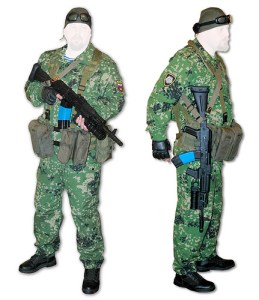
He went through a spate of attending Airsoft events; groups of males dressed in a wide variety of camouflage kit, running around abandoned military sites and shooting each other. I have been banned from collecting him from these events due to the fact that I can’t help sniggering at middle-aged men dressed in black combat gear and huge boots who strut around trying to look dangerous – and failing.

The boy is very conscientious about the rules and regulations. All guns are kept in their cases and covered up in the boot of the car when being transported. Some of them are very realistic and could give rise to fears of terrorism should they be spotted by a passerby.  When not stalking other Airsoftees, he and a friend have access to a secure area of land where – if they wanted to – they could shoot hapless bunnies. They haven’t shot any yet and prefer to demolish innocent cans and containers instead.

One of our garage windows took a direct hit when he was testing a new gun out of the bathroom window, and our patio is spattered with paintball splodges and environmentally unfriendly plastic BBs that hurt like hell when you tread on them in bare feet.

There is a corpulent pigeon that lurks beneath the fat ball container  in the fir tree, waiting for fallen seeds from the Dunnock flock who frequent it. The boy has sworn to exterminate it but so far it has been too quick for him.

Of late he has expressed a desire to join the army – but only in the intelligence corps – he has no intention of being cannon fodder. Do we still have cannons?

He is twenty-one and a man, now so he has to make his own choices in life.

There is a song by Al Stewart that has been running through my head since I started writing this.

‘Shot hit the night, a bullet lodged in his brain.

He must have died instantly, he felt no pain.

As the crowd turned to go, a man was heard to say

“Oh, he must have had it coming to him anyway.”‘

I can’t like the sound of gunshots.


Performance – The Cradle Song 1977 – Week 15 of the 52 week short story challenge

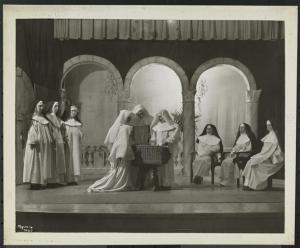
chappies 2

The scene is set.

An elegant Regency-style room with huge shuttered windows that looks out onto terraced lawns and rhododendron bushes.

A group of first-year drama students, mainly female, seated in incongruously modern plastic chairs in a semi-circle clutching small books with soft blue paper covers. The door opens  and all heads turn to see the vision that is their director. In turn, he peers at them over his half-moon spectacles, adjusts his cravat and perches on the edge of the table placed in front of the group.

‘Well,’ he says, his eagle-like glare sweeping the room. ‘ You seem like a pretty mixed bunch. I see that you all have a copy of the play you are going to perform at the end of term. Your performance will take place in this room in front of the rest of the students and the other directors. We don’t let you loose in the theatre yet unless we are desperate for extras in our crowd scenes. I have a list of your names here and as I know nothing else about you, I would like you to read some of the script as indicated. For those who may not have come across this obscure little play by an equally obscure little Spanish author, it has not been chosen for its merit but because the majority of parts are female, we have a good stock of habits in wardrobe and I personally prefer it to ‘The House of Bernarda Alba’ by Lorca which is the other old warhorse that gets trotted out periodically when we have a glut of female students.’

He pauses for effect and scans his audience. Blank faces. A tough crowd. He sighs and fans his face with a copy of the script.

‘In  a nutshell; a baby girl gets dumped at a convent and is adopted by the local doctor and brought up by the nuns. Sister Joanna forms an unhealthy attachment for the girl now named Teresa. Not surprisingly, Teresa grows up with a desire to leave the convent and is swept off her feet by the charming Antonio. We jump over the years to the day that she turns 18 and goes off to be married. There are four male parts so one of you boys will be the stage manager. I am not looking for impeccable diction or RSC-level acting at this stage. If you have a  regional or cultural accent  do please try to overcome it so that I can understand you.  We will start at this end.’

The read through begins.

THE CRADLE SONG

GREGORIO MARTINEZ SIERRA

 CHARACTERS

Sister Joanna of the Cross, 18 years of age.

Teresa, aged 18.

The Prioress, aged 40.

The Vicaress, aged 40.

The Mistress of Novices, aged 36.

Sister Marcella, aged 19.

Sister Maria Jesus, aged 19.

Sister Sagrario, aged 18.

Sister Inez, aged 50.

Sister Tornera, aged 30.

The Doctor, aged 60.

Antonio, aged 25.

The Poet.

A Countryman.

Also a Lay Sister, Two Monitors and several other Nuns, as desired.

 Most of the students have already checked the cast list and skim-read the script to see which parts are the best. With one eye on the passage they have been asked to read and the other on their director, their progress is interrupted regularly by the director telling them to skip certain parts and pass on to a designated page with more interesting dialogue. The director’s pen scribbles next to the names on his list and the students try to work out from his reaction, whether they have done well or badly.

Some people are asked to read another section and those who aren’t feel unsure as to whether this is because of their poor performance or because the person being asked to read again has messed up the first time.

The director’s expressions are impossible to analyse; not because he is inscrutable but because his face contorts through the whole range of manufactured emotions as he scribbles on his list.

At last the torture is at an end. The director gets up and walks round the table in order to sit behind it on the rather grand carved wooden throne already placed there. He steeples his fingers, elbows leaning on the table and his list in front of him, peering over his spectacles as his eyes move from one end of the semi-circle to the other. He is a master at drawing out the suspense.

‘Boys! Stand up and sit down once you are cast. You – tall lad with blond hair – you have an unfortunate glottal stop so you will be the stage manager. Small Scottish person – your accent is virtually unintelligible so you can be the Countryman; he doesn’t have much to say and none of it is important anyway. Pretty boy in the blue shirt – you will be our Antonio but you will have to be a bit more butch dear, an 18 year girl needs to fall in love with you. Older chap with the designer stubble – grow a beard and you will be a passable Doctor if we grey you up a bit and add some lines. Last man standing – you will be our Poet and you have some lovely lines to deliver so let’s see if we can do something to iron out your Brummie accent.’

The last of the boys sits down. The female students stand up.

‘Okay girls. I am glad to see that you are not all innocent 18 year olds. Take no notice of the ages of the characters on the cast list, the only one who has to look young is Teresa. She ages from a baby to a teenager. Don’t worry, we have a swaddled baby doll for the start of the play. We don’t let students play with real babies. Now, you with the short brown hair. You look about 12 so you will be Teresa. Try to stay looking sweet and innocent dear however many debauched parties you attend. Older woman at the end – you are my Prioress. Girl with the gold-rimmed specs – you look as if you could be a bit severe so you are the Vicaress – keep the specs on. Chubby girl from Yorkshire – Mistress of Novices. Girl next to you with the dramatically crossed legs – Sister Joanna – I have a feeling that you can rise to the challenge of emoting to order. Those left standing – there are five sisters with strange Spanish names left and Senor Sierra gives us some latitude to add nuns and lay sisters as desired so all seven of you will wear a habit and have very little to say. Everybody happy? Probably not but I am not in the business of making students happy. It doesn’t happen in the real theatre so you’d better start learning how to cope with disappointment now. Class over, I need a lie down. Go out in the garden and start learning your lines.’

He sweeps out of the room as swiftly as he had swept in.

The students who have sizeable roles try not to look too smug. The seven sisters and the stage manager do their best not to look too upset.

As the performance date approaches; lines are learned, those who had slushy diction are given extra speech exercises and stage make-up classes focus on the unsubtle art of aging. The director in charge of the wardrobe department kits the students out in their white habits and wimples, with suitably rustic outfits for the Doctor, Antonio and the Countryman. The Poet preens in his dinner suit and dicky bow.

Rehearsals are an education. The Prioress has no problem with being serenely in charge, the Mistress of Novices clucks her way around the spare nuns and Sister Joanna over-acts to her heart’s content, often leaving poor Teresa bruised from her enthusiastic embraces. The girl in the gold-rimmed spectacles delivers the lines of the Vicaress sternly –  as directed.

The director asks Joanna to rein it in a bit.

He stands in front of the Vicaress as she delivers her closing speech. He frowns.

‘TOO unemotional dearie. Could you manage to squeeze out the teeniest tear for me during that last speech? You could borrow some from Joanna, she has them in spades.’

‘I’ll do it for the performance.’ says the girl with the gold-rimmed spectacles.

The director looks dubious.

‘I’ve heard that before and I’ve witnessed many a failure. I’ll believe it when I see it but the whole play hinges on that tear.’

No pressure then.

On the day of the performance the Regency Room is packed.

Watching from the room next door, the students try to quell their butterflies. Joanna delivers very audible deep-breathing and speech exercises that make everyone else feel a bit inadequate.  The girl in the gold-rimmed glasses wishes that she could have done her part without spectacles so that she didn’t have to see the audience.

It doesn’t go too badly in the end. Everyone plays their part and Joanna emotes and acts everyone else off the stage until the closing moments.

[All make ready to go out sadly. The Vicaress sensing the situation, to her mind demoralizing, feels it to be her duty to provide a remedy. She, too, is greatly moved, but making a supreme effort to control herself’.]

VICARESS. One moment. I have observed of late . . . that some … in the prayer . . . have not been marking sufficiently the pauses in the middle of the lines, while on the other hand, they drag out the last words interminably. Be careful of this, for your Reverences know that the beauty of the office lies in rightly marking the pauses, and in avoiding undue emphasis on the end of the phrase. Let us go there.

[The Nuns file out slowly. Sister Joanna of the Cross unnoticed, remains alone. With a cry, she falls upon her knees beside an empty chair.]

 The girl in the gold-rimmed spectacles pulls it off. She delivers her last speech, stony-faced with one single tear rolling slowly down her cheek. Controlled emotion in no way diminished by the fact that Joanna is having hysterics over the empty chair vacated by Teresa.

Make-up and habits are left in the dressing rooms as the cast return to have coffee and biscuits with their audience. Joanna remains in the dressing room trying to control her emotions and cover up her red-rimmed eyes. When no one comes looking for her she sidles into the room and picks up a cup of cold coffee. One of the directors tells her that she looked like a bent banana and that she needs to learn more self-control in future.

The director of the play gives a brief but approving pat to the shoulder of the girl with the gold-rimmed spectacles.  Another director, who is also the deputy principal of the college, smiles at the girl and congratulates her.

‘I’ve seen that play so many times over the years but no one else managed to produce that tear so effectively. You did well.’

It is a lesson learned.

Don’t be deterred by people who tell you that you can’t achieve something when you believe that you can.

MNY32121

A Villain’s Perspective – Week 14 of the 52 week short story challenge

8167868_orig

I should have known that she meant trouble for me. There was something about that bird that really wound me up; she really knew how to push my buttons.

I was fresh out of college and in my first job when I met her. It was at an induction course for new staff and I was scheduled to do part of the health and safety briefing. I was a bit nervous when I saw the sea of faces in front of me but I got through it and handed over to Joanne; technically my senior, who was going to talk about safety at work.

Unfortunately for Joanne, she decided to wear a pair of high-heeled shoes that would never meet H & S standards; she fell off them on her way to the stage and had to be helped to reception for a check from a first aider – who was due to give his own talk half an hour later.

I went back and delivered Joanne’s talk and in order to fill out the time I asked if there were any questions.

Bad idea.

A hand shot up.

‘Health and safety regulations apply to all staff, don’t they?’ She didn’t look sarky as she said this.

I nodded.

‘So, all staff should be wearing clothing and footwear appropriate to the work environment, shouldn’t they?’

Slow on the uptake, I nodded again.

‘I’m sure we are all very sympathetic about the young lady’s unfortunate accident, but if she had complied with regulations as you suggest…’

The sarky bird laughed. They all laughed. I blushed. My confidence gone, I looked helplessly at my boss Carl. He came on stage and gestured for me to leave. He joined in the laughter and apologised but pointed out that he couldn’t have had a better example to emphasise the importance of adhering to health and safety regulations if he’d tried.

I felt gutted. He had them in the palm of his hand. He was on my hit list and so was the sarky bird in the audience.

I didn’t even have to try to get rid of Joanne; she was demoted to the post room and I was bumped up to Carl’s deputy. Not much of a promotion considering there was just the two of us, a secretary and two work experience girls, but I was on my way.

Getting rid of Carl was complicated; people liked him and he had worked for the company for ten years. He was getting complacent though, happy to leave much of the work to me and the clerical staff. I soon had them all eating out of my hand; I knew the importance of turning on the charm.

After a few months of surreptitious cancelling and rescheduling of orders, meetings and training, Carl’s star was sinking and he accepted a sideways position into another branch of the company when it was suggested that he had lost his grip on the whole facilities issue. He never found out that I was the one who had sabotaged his work.

They interviewed me for Carl’s job and not surprisingly, I got it. He gave me a brilliant reference. Fool.

My next goal was to build up my very small team into something more impressive. It wasn’t hard; a mastered the art of being extremely accommodating to senior managers and effective at saving money. Why pay out for professionals when you can get it done on the cheap and earn yourself extra brownie points? The building janitors came under my remit now and I used them to carry out maintenance and delivery jobs that had been contracted out previously.

Okay, so they weren’t that good at carpentry and the shelves and worktops they put up were a bit dodgy, but they could paint walls, move office furniture and weren’t averse to a bit of unofficial work after hours if given sufficient sweeteners.

One of the work experience girls had taken quite a shine to me – and I fancied her too. I waited until she had gone back to school and turned sixteen before I made our relationship official of course; knocking off underage schoolgirls in office hours would not have gone down well – however tempted I was. She wasn’t terribly bright and had made a hash up of every office job I gave her but she was tall, blonde, very attractive and could be relied upon to do as she was told. My ideal woman.

The retirement of the canteen manager gave me my next opportunity to increase my empire. I would have responsibility for a cook, three kitchen assistants and a healthy budget to play with.

Saving money in the canteen was child’s play. I found a cheaper food supplier and changed the menus. The cook objected to the poor food quality and handed in her notice. The company marched on its stomach and as a consequence a replacement cook who didn’t care too much about good ingredients was appointed.

Most of the staff  were happy with chips; with fish and mushy peas on Fridays, sausages, burgers or pies during the rest of the week. I made sure that there was cheap salad available as I had already experienced the pointlessness of taking on the stroppy vegetarians.

My child bride and I got married – she was eighteen and pregnant by this time.

There were a few people who weren’t deceived by my charms; if they were on the same management level as me or lower, I did my best to undermine them. I was getting good at this game. Most senior managers realised that I was an asset to be used to their advantage; there were a couple who were cool and distant in their dealings with me. I was very careful not to cross them.

By the time I came across the sarky bird from the induction again, I had a son and a daughter, and a wife who was bored with being at home. She got suspicious when I took to working later than usual. She wasn’t that daft; there was a seventeen-year old cleaner who had added spice to my life. We would meet up for swift but exciting sex in a disused office when the building was deserted.

At about the time my wife was getting to be an unnecessary irritation, a new project team moved into the building. I was told to find temporary accommodation for them and ultimately an office – or two – as the team expanded. I was called in to a meeting with the senior manager in charge of the team and his team members – one of whom was the sarky bird from the induction.

‘Goodness me Adrian!’ she said. ‘Haven’t you risen up the ladder since the last time I saw you!’

I blushed and the other occupants of the room demanded to know what she was talking about.

She told them; she built up the story enough to make me look a total prat. They all laughed, not with me but at me and the sarky bird rose up to the top of my hit list.

After that, it was war. I did my best to make life as awkward for her and her snotty team but each time I did, she managed to put a halt to my plans.

The most embarrassing and potentially damaging thing she did was to grass me up to HR.

I had arranged for my wife to work in my office in the mornings – on a temporary basis – we used her maiden name because you weren’t supposed to have a spouse working for you. This had been a happy arrangement for about a month when I got a call from HR asking me when I had interviewed for a temporary office assistant, how many others had been interviewed and was it just a coincidence that the new employee and I had the same address?

It was a close thing. I could have been demoted or even lost my job but with a bit of careful briefing, my wife and I told a good story about her depression and her need to be out of the house again. I blamed my ‘bending’ of the HR rules on my love and concern for my family.

Success.

My wife was transferred to another office, and though she was still on a temporary contract, she was kept busy there during the mornings and I didn’t have the trouble of finding her meaningless jobs to do. That was someone else’s problem now.

I had no proof that it was the sarky bird that dobbed me in but the fact that she and her team members seemed to find me a constant source of amusement, and refused to treat me with the respect I deserved, that was enough proof for me.

It was war.

Trouble was, it was war on both sides.

My wife found out about my after-hours meetings with the office cleaner. A friend of a friend of the sarky bird in her new team told her and my life was hell at home and a work for a while. I had to sack the cleaner – which upset the other cleaning and janitorial staff. My wife went on strike when I came home from work and it took shedloads of expensive presents to get back in her good books. She really wasn’t as stupid as I thought she was.

Further cuts had to be made in the budget and it was decided that we would close the office building down and move the staff to a more central location.. We received a good offer for the land if the building was demolished and the new office building was only half-occupied so there was plenty of room there.

I got two of the most expensive estimates I could find for moving the furniture and equipment the three miles into town. Then I undercut them drastically by using our own janitors, hiring a couple of white vans, some large plastic crates and getting the staff to pack up their own offices.

Not surprisingly, senior management jumped at the chance of doing things on the cheap. We had a bit of a near miss when it was alleged that we had bats in the roof of the building though. As they were a protected species we couldn’t get the building demolished until the relevant inspectors had been in.

The crates arrived and were stacked up in the corridors. I got one of my staff to draw up a rota as to which office was moving and when. I saved more money by reusing the crates and going into the new offices to ensure that the staff were pulling their weight and unpacking quickly.

The bats turned out to be temporary residents so there was even more reason to get everyone moved and smash the building down.

There were more opportunities for promotion in the new building. I just had to pull this office move off first.

The sarky bird had moved on to another team; just to add salt to the wound, she had been appointed to a job that my wife had been turned down for. This new  team inundated me with demands; room for larger desks because of health and safety issues, storage for confidential files, an accessible meeting room – the list just grew and grew.

A few more cracks appeared in my master plan. I had told the staff to put as much as possible in their pedestal drawers – this meant that I needed fewer crates. The drawers had very small wheels however and the combination of ham-fisted janitors, bumpy car parks and tiny wheels meant that there was a large casualty rate amongst the pedestals – which cost a great deal to replace.

Then there was an accident.

Someone – and no one ever owned up to it – left a crate in an office doorway. A member of staff tripped over it and broke their ankle. I got my secretary to send out an email telling staff not to block doorways and corridors with crates so I couldn’t be held responsible.

We were down to the last week of the move. I was shoving a large desk up the corridor on my own when the sarky bird walked past.

‘Adrian! You should know better than to be moving heavy furniture on your own. Health and safety regulations! You wouldn’t want to have another accident on your conscience now would you?’

I growled.

She sniggered and went back to her office.

The final crates were stacked outside her office. Maybe the crates were piled a bit high but we were in a hurry.

There was another accident.

The sarky bird’s manager told her to get a crate down from the stacks to pack away some specific equipment. As she lifted the crate free from the stack, another one fell on her foot and damaged her toe.

I did my best to cover my back again but senior management laid the blame at my door – and at the door of her manager. They suspended her on a number of allegations regarding the disclosure of information about the workplace but as the accident led to her being off work for more than nine months the Health and Safety Executive had to be involved and all the allegations were dropped – apart from the allegation that she made sarky comments about senior managers – me included.

The upshot of it was that the company had to accept full responsibility for the accident and pay damages to the sarky bird. She also got a reference and pay in lieu of notice. I got demoted, and my wife got a job that she hated so much that she took it out on me at work and at home.

Okay. Other people lost their jobs because of me. Other people got injured. Senior managers stepped aside and laid the blame at my door and instead of being grateful for my having saved them a great deal of money, they also blamed me for the damaged pedestals and low morale amongst the janitorial staff.

I don’t think of myself as a villain.

I blame the sarky bird.
smiley toe

Inside a car – Week 13 of the 52 week short story challenge


I woke up when he drew back the curtains and the bright shaft of sunlight hit my eyes.

He turned to me and grinned.

‘Let’s go to the seaside. It’s gorgeous out there.’

I never need to be told twice.

It took him slightly longer to get ready than me but then he has to take his paraphernalia with him; wet suit, surfboard, shoes, towel, shorts. I travel a lot lighter.

Outside the sun is even stronger and after we are seated, he opens the car window for me, knowing how much I like to feel a breeze in my hair.

We live about half a mile from the beach; he has surfed at better places but on a day like this we don’t want to be driving for hours. I can see how happy he is at the thought of being in the water again, and although I’d rather stay dry, I can appreciate his eagerness to get in the sea on such a lovely day.

It’s still early and there are no other cars in the car park when we arrive. Aware of the fact that the fine for not paying the car park fee is pretty steep, he nips out of the car, buys a ticket and displays it on the dashboard.

I sit tight whilst he unloads his kit; I know better than to get in his way.

Making sure that he has everything he needs, he comes back into the car and sits beside me, ruffling my hair and smiling.

‘I won’t be long. See you soon.’

And he is gone.

The window is open a couple of inches, and at first the fresh breeze that blows through it takes the edge off the sweltering sun but as the sun moves up in the sky and the breeze changes direction I start to feel uncomfortable. I wriggle down in my seat in order to avoid the heat but it doesn’t help.

Looking over my shoulder I see that the back seat is still in the shade. It means moving away from my window but he said he wouldn’t be long. I clamber between the two front seats; it’s a tight fit but eventually I am on the back seat and it is much cooler.

Time for a doze. I was up early this morning after all.

I don’t know how long I was asleep but a knocking on the window wakes me and I sit up with a start. It’s really hot in the car now and the sun has moved again so that I am directly in its glare. The front seats are just as bad and I am so thirsty.

I hear the knocking again and look up to see a woman peering in at me, shading her eyes against the strong sun. I don’t make a sound though because I know he will be back very soon and all will be well.

The woman stops knocking but I hear her talking into her phone. The words are indistinct. I squeeze myself into the tiniest patch of shade left in the very back of the car where he usually keeps his surfing gear.

There is a bag of food and drink there and I sort through it looking for anything to slake my thirst. I know that I shouldn’t be doing this but I’m beginning to feel desperate. He isn’t usually gone this long. Something must be wrong.

The woman comes back and she has some other people with her. I look for his face in the crowd but it isn’t there.

There is a woman in a uniform outside the car now. She taps on the window trying to attract my attention but I sit very still and do as I have been told.

A car draws up beside her.

It is a police car. I know this because he has told me all about them when we are out driving. He always drives more slowly when he sees one of these cars.

I can hear the people talking outside the car again.

The man from the police car moves to the passenger window and I shrink back as he smashes his metal stick into it. The glass goes all over the seat and I hope that I won’t be blamed for the mess.

He opens the passenger door and reaches through to open the rear door. I am torn between fright and the relief that I feel from the rush of air that fills the car.

The woman in the uniform climbs into the back seat and sits down. She is smiling so I think that perhaps I may not be in trouble after all.

‘Come here sweetheart. Come and get some fresh air and a drink.’

I am so hot and thirsty that I do as she says. I climb over the back seat and sit beside her. She strokes my hair and helps me down out of the car.

I don’t make a sound; not even when she slips a collar over my head and attaches a lead.

‘Good girl,’ she says, and I follow her to a shady spot where a bowl of water is waiting for me.

I lap at it and wait anxiously while she refills the bowl from a plastic bottle.

The policeman is looking at the parking ticket. He does not look happy.

‘I’ve checked the temperature out here – 27 degrees – according to this ticket she’s been in the car for nearly three hours. ‘

The woman in uniform shakes her head in disgust. The policeman has already asked the people in the crowd if they know who owns the car, but they all came to the car park after us so they wouldn’t have seen him go off with his surfboard.

Then I see him.

He is limping and a man in red shorts is supporting him and carrying the surfboard.

He tries to break into a run when he sees the crowd around the car but he falls over and the policeman rushes to help pick him up.

‘Is she okay? I didn’t mean to be away so long. I twisted my ankle and had to wait for some help.’

The policeman and the woman in uniform still look very stern.

‘She was very hot and thirsty. Have you any idea how hot it was in the car? You parked it in full sunshine. We had to break your window to get her out. Another half an hour and she would probably have been dead.’

‘I’m so sorry. I only meant to have a quick surf before taking her for a walk along the beach.’

The woman in uniform shakes her head again.

‘You should never leave your dog unattended in a car at all. How would you like it if someone put you in a thick fur coat and locked you in a car with little fresh air and nothing to drink?’

He is sitting on the edge of the driver’s seat now with me in his lap.

I lick his face.

It is salty but not the kind that comes from the sea.

The man in the red shorts has strapped up the twisted ankle and although I can see the pain on his face, my man says that he can manage to drive us home.

The policeman takes his details and says that he might be taken to court for animal cruelty.

The woman in the uniform is looking less stern. She has been watching me as I settle happily against him, my paw on his arm. He is mine and he is tethered and safe.

She strokes my head and I smile my doggy smile.

‘She’s had some water. I think we caught her in time.’ She turns to the policeman and shakes her head but this time she is smiling.

‘Do you live far away?’

‘About ten minutes drive.’  I have never seen my man this unhappy and I lick his cheek again. He buries his face in my hair and holds me very tight.

‘Go on. Go home and get some ice on that foot. RICE! Rest, ice, compression and elevation. I can see a little dog who will be very happy to make sure that you keep off that foot.’

The lady in the uniform is still smiling as we drive away. I am in the back seat because of all the glass where I usually sit.

We drive home slowly and he keeps telling me how sorry he is and how he will never do it again.

I know that he won’t and I am happy.