Lost and Found – Week 6 of the 52 week short story challenge

1495392_10152762176544871_125551827691198947_o  

Lost and Found and Lost Again

Rochelle sat on the rocky outcrop at the end of the beach. Her beach. The beach she had known all her life and the place she sought whenever life became too much. Unfortunately life became too much for Rochelle every day until she could push it aside with her current cocktail of choice. She had been told to avoid alcohol because it could have an adverse effect on her medication but ‘could have‘ was not a definite and there were days when avoidance was impossible.

The youngest of four girls, Rochelle was often referred to as ‘the Afterthought’ by her older and married sisters. They were all in their teens when their mother surprised them – and their father – with the birth of a tiny and delicate sister who was duly fussed over and petted by them all.

Perhaps as a consequence of this concentrated attention, Rochelle was a demanding baby; the toddler who invented new levels of tantrums, and the most sulky and erratic of teenagers. Mercifully for her sisters, they had married and set up their own homes by the time she had reached this most petulant and attention-seeking phase of her development.

Her father was bewildered by Rochelle’s behaviour. His other daughters had seemed so easy by comparison. Her mother continued to dote and spoil her pretty little girl, enchanted by the sweetness of her nature – provided things were going her way.

School was a trial for Rochelle. She made few friends but many enemies due to an unfortunate ability to tell tales with a mask of complete innocence that belied her devious nature. Tears and tantrums failed to move her teachers and she left school without any qualifications due to an extensive sickness record and no ability to apply herself to anything but craftwork.

Expressing a hitherto hidden desire to get away from home and family, Rochelle informed her parents that she wanted to go to college. A college on the mainland. A college far away from home. Puzzled by this desertion, Rochelle’s parents applied a few sanctions. She could go to college but only if she agreed to stay with Mr and Mrs Bullingham, elderly family friends who could guarantee to keep her safe from the wicked world.

It was agreed and having been escorted to her new home by her tearful mother, Rochelle settled into her new life. ‘Settled‘ may not have been the best description of how she spent her days. The college was small, more like a finishing school for young people whose parents were not ready for them to tackle the hazards of big city life. Many of her fellow students paired up throughout their time at college but not Rochelle. Some of the boys – and teachers – found her childish behaviour initially enchanting but the magic wore off very quickly and they soon realised that she was a person to be kept at a distance.

Rochelle learned how to flirt and flutter her eyelashes in order to get others to do things for her. She also developed a taste for alcohol; only to be consumed in her room or when she wasn’t due home to the Bullinghams’ genteel and alcohol-free zone for some time.

The college course came to an end and Rochelle returned home to her island, still without qualifications but possessed of a multitude of manipulative skills. She had made a few friends who kept in touch – perhaps because they felt sorry for the girl who didn’t seem able to grow up. To those who cared for her, Rochelle continued to be sweet and charming. Her sisters loved her but grew increasingly intolerant of her demanding behaviour – especially when she had been drinking.

Gentle suggestions regarding Rochelle finding work were rebuffed and met with floods of tears and prolonged sulking. Employment on the island  was limited anyway but for a young woman with little experience, no real skills and an air of naivete that did not transfer to the workplace, it was impossible. Rochelle’s parents came to the conclusion that she was unlikely to ever make a financial contribution to their household.

Being of a sensitive and rather sentimental nature, getting Rochelle involved in voluntary work for animal charities on the island may not have been the wisest of choices but it kept her occupied and her craftwork earned small amounts for the darling animals. She felt that she had found her true calling at last and was quick to tell her friends of her new purpose in life.

Her sisters however, grew increasingly concerned about Rochelle’s mental health, especially when she was at home or attending family events. She screamed and cried; retreated to her room when she couldn’t have her own way and had to be rescued from bars when her cocktail consumption got her into peril with men who were less scrupulous than her college chums.

There was a spell in hospital during her mid-thirties; life had become too much after Rochelle developed a crush on the much-married manager of the seal sanctuary. She stalked him and bombarded him with handmade cards containing coy messages. He succumbed to Rochelle’s childlike charms but panicked when she announced that she was with child herself. His wife found the bag of love tokens when emptying out his recycling and after talking to her repentant husband, contacted one of Rochelle’s sisters who in turn spoke very sternly to her parents.

The problem with living on an island is that the only strangers were tourists; everyone else knew each other and in order for Rochelle to escape the laughter and mocking glances, her parents had her admitted to a small private hospital where she was kept under heavy sedation following her ‘operation‘ and  caused her to retreat further into the safety of her fantasy world.

By the time her doctors felt she was well enough to go home, the manager and his wife had been relocated to the mainland, and another scandal had replaced Rochelle’s assumed shame. She made more friends whilst in the hospital; women who had been damaged and made vulnerable by life, women who saw Rochelle as an entertaining child, a willing drinking-companion, and a person unfazed by their own bizarre behaviours.

As the years passed, Rochelle’s sisters gave up on the idea of ever finding a man patient enough – and wealthy enough – to take their sister away from their aging and increasingly frail parents. They did their best to try and encourage some element of maturity in their baby sister, but she remained that – a child-woman who was incapable of doing more than making chocolate-box cards for animal charities and stamping her foot when life failed her.

Through one of her old college friends, Rochelle became acquainted with Trudi, a woman who had spent some years recruiting people for a demanding religious sect. As a consequence, she was adept at spotting those who life had left open to exploitation. She honed in on Rochelle; showering her with compliments, feeding her ever-hungry ego and grooming her as a useful source of information as well as a potential mouthpiece for Trudi’s opinions.

Trudi had a lucrative business selling email addresses to companies who used them to spam and intimidate people who had no interest in their services – especially the elderly. Several of her friends had become wise to this misuse of their details and Trudi found herself needing a new method of obtaining information.  Rochelle fell for Trudi’s explanation of needing email addresses to raise funds for charities – animal charities of course – and was quick to use her volunteer status to find mailing lists of anyone who had ever made a contribution. Trudi was ecstatic, and clever enough to get Rochelle to use her own email address when sending on the information. She paid Rochelle a token amount and kept the rest of the money  to herself.

Rochelle watched the police car draw up outside her house with some curiosity. At 53 years of age she had never seen a police car at her house before and idly wondered if her parents were alright. She turned back to the sea again and barely registered the crunching of police-issue boots on the shell and gravel beach. Rochelle’s mother had tried to persuade the police that her daughter had mental health problems but some of the people on the lists sold via Trudi’s dubious transatlantic contacts were from old and very influential island families who objected to being inundated with emails peddling Viagra, funeral plans and weight loss products.

One of Rochelle’s sisters met them at the police station and acted as her appropriate adult. Rochelle didn’t really know what to say in response to the questions. Tears and eyelash fluttering failed to move the stony-faced female detective and her equally impassive male colleague. After hours of questioning, Rochelle’s sister requested a break and took the opportunity to give Rochelle the kind of talking to she had badly needed all her life

Eventually Rochelle was persuaded to give up Trudi’s details and tell the version of events as she understood it. The detectives weren’t convinced that anyone could be as gullible as Rochelle but had little choice to let her go with a caution and a very stern warning about getting involved in this kind of scam in the future.

Unable to trust Rochelle, the animal charities she had previously supported made it clear to her parents and sisters that her services were no longer required. Her computer had been taken away by the police and her parents stated that they didn’t want it returned. Those friends she had kept in touch with via social media wondered idly what had become of her but no one cared enough to find out. Trudi was tracked down and despite blaming everything on Rochelle, her past track record gave her away and she was exposed as the force behind many other such scams.

Rochelle spends most of her time on the rocky outcrop; lost again but unlikely to be found this time.



That London – Week 5 of the 52 week short story challenge


img011

When my parents split up, there were just over six weeks before the end of the summer term. During that time I was catching two buses to get from one side of the town to the other. This came to an end when I got run over by a green station wagon at a busy crossroads in the middle of the main shopping area. It wasn’t a terrible accident. The car was slowing down at traffic lights, I sustained a grazed knee, cut my ankle and found myself sitting in a daze on a traffic warden’s gabardine mac, holding up traffic while an ambulance was called. I can still remember the smell of the coat and the confusion of crossing the road one moment and being flung up and out into the middle of the crossroads.  I would probably have been patched up at A&E and sent over to my mother – who was working on the hospital switchboard – but the kindly traffic warden insisted on picking me up and putting me in the ambulance. He bumped my head on the roof and concussion was added to my hitherto minor injuries.

It was enough to make my mother move me to a junior school closer to my Auntie Dee’s  and although I had the sporadic protection of my three male cousins, it was hard trying to make friends, especially as the accident had left me so frightened of crossing roads that I didn’t play out much. The other problem I encountered was that my fellow pupils had trouble getting to grips with my name: Cheryl, Shirley, Cherie were just a few of the variations. In desperation I announced that my name was Fred, and it stuck, much to my mother’s horror.

‘Why Fred?’ She said. ‘Any name would have done, but Fred!’ I shrugged, thinking that people would forget it by the time I moved up to secondary school in September. They didn’t. It stuck. It probably endured because in an all-girl school, our little clique consisted of Lee, Jo, George and me, Fred. Even the teachers – the more civilised teachers – called me Fred. The sub-human teachers – especially the hag who pretended to teach geography – treated me with the disdain reserved for anyone out of the ordinary.

Fred was not the good little girl I had been at junior school. Fred was an embryo rebel who lived in a bedsit with her mother and who had waved goodbye to a normal family life. She drank barley wine and hung around the student union bar on Friday nights when most of her peers were at youth clubs.

Within our group, it was George that was my best friend. She lived in the ground floor of an elegant detached house split into two flats. Her dad – also called Fred – was an aging hippy married to a much younger woman. George and her two older brothers treated their bewildered stepmother with a rudeness that the poor woman had done nothing to deserve. Their own mother had done a flit many years before, so she wasn’t to blame for the splitting up of their ‘happy’ home.

From all accounts George’s mother had been at the centre of the London party scene when George’s father met and married her. She knew rock stars and actors and after reluctantly bearing three children, had returned to her roots leaving confusion in her wake. George and I were thirteen when we went to stay with her in London for a very long weekend. We were so excited.  ‘That London’ was a place of magic and mystery; a place you went to on heavily supervised school trips to see exhibitions at the V&A, or the much vaunted Tutankhamun exhibition. I went to that one, I queued for hours, I brought home a paper carrier with King Tut’s death mask on it and not much else. I was older and more cynical by that time.

Our trip to London started well. We were met at Waterloo station by George’s mum. She presented us with make-up boxes from Harrods and took us out to dinner at a chic Italian restaurant round the corner from the three-storey Chelsea mews that she was looking after for friends. Until that moment, spaghetti bolognaise was something that Crosse & Blackwell did and it came in a small or a large tin. I may have turned my uneducated nose up a bit at the authentic Italian version. Okay I did but so did George. Her mum plied us both with red wine and thought it amusing when we got a bit squiffy. She was not quite so amused when we both threw up later that night. We had to clear it up ourselves though. She was far too gone and shut herself into her bedroom to avoid  the heavings and the smell.

She took us to Biba the next day and I spent 75 pence on a black scoop necked tee-shirt with yellow and black striped sleeves. The only Biba item I ever owned and I kept for years afterwards  even though it made me look like a bumble bee. That afternoon we went to the Odeon cinema in Leicester Square, saw ‘What’s Up Doc’ and gorged ourselves silly and hyper on unsuitable snacks. More upchucking ensued after a bumpy taxi ride home.

By Sunday we had spent nearly all of George’s mum’s limited funds and relations were rather frosty when we failed to show sufficient appreciation at being taken to the jousting at the Tower of London before being put on the train to come home. I was in disgrace because I had wanted to wear my favorite purple needlecord jean jacket. She said it was common  so I had to swelter in my shiny black PVC mac – with stick on cherries. Parting was not sweet sorrow. We were ungrateful brats and hell would freeze over before she ever invited her daughter – and her daughter’s equally obnoxious friend – to stay.

I think that our joint upchucking and hangovers after all the red wine had set the seal on our stay. George’s mother didn’t have a maternal bone in her body and we stopped being amusing when we started making a mess. We stood in the corridor of the train and sang King Crimson songs all the way home. Our fellow passengers weren’t exactly enthralled by two scrawny teenagers warbling ‘21st Century Schizoid Man’ and scowling at anyone who came out of the carriage to use the toilet.

Being only 40 minutes away by train, London was accessible to us, and became even more so as I moved into my mid-teens. I nearly had a very exciting meeting with a famous person. I was doing a project on Edward Gordon Craig – actor, director and scenic designer – as part of my ‘A’ level drama and theatre arts. I came across an advert in The Stage regarding research into the actress Ellen Terry – Craig’s mother. I wrote off to the box number and was delighted – not only to get a reply but an invitation to meet up at the V & A.  My mother had visions of me being kidnapped, raped or worse by some wicked theatrical type and so I wasn’t allowed to take up the invitation. Poor Nigel Hawthorne – I think I would have been safe with him somehow.

I became more blase about going up to London; shopping trips to Oxford Street, live music at the Hammersmith Odeon, the occasional matinee. It was a place to pass through en route to somewhere else when I was at college in Birmingham but never a place to actually live.

When our youngest was four we planned a mega trip to that London; he and his brother thought we were just going to visit Daddy’s airport and were gobsmacked when we climbed aboard a Luton-bound Easyjet. A train to central London, the underground and a sight-seeing trip on a double decker bus. The boys loved it – especially when we arrived at the Science Museum. We were going to take a trip on the Thames but time ran away from us.

I had always been quite chilled on my previous visits to the capital, but with two small and inquisitive boys in tow, my maternal instincts had me seeing perils round every corner. A fear of pickpockets and muggers outshone that wonderful Tube station scent that I knew so well. We survived it though and my baby boy announced that it was his best birthday ever.

Our most recent trip to that London was in the year of the Olympics. We were given free tickets to go on the London Eye and as we were spending a week down South to see family, we took the opportunity to travel up by train.  Our eldest son was away at Uni but being the intrepid train traveller that he is, he planned our journey and acquired the tickets for the trip.

I was less fearful on this trip. I like being on trains and so does my husband. My six foot baby boy was less enamoured – especially with the people who used their phones on the quiet carriages. The London Eye was wonderful and the boat trip that was part of the package enabled us to catch up on the experience we had missed out on years before. My baby boy liked London – but only if there weren’t any people in it. They spoiled.

That was my London. I’ve no desire to go back. Liverpool and Manchester are sufficient for me now.


Three Siblings – Week 4 of the 52 week short story challenge

stick-figure-unhappy-family-fun-cartoon-divorce-abuse-concept-33512931

I came back to work after a week’s holiday and found the Bennett family in residence. Two girls and a boy; they were withdrawn and several of my colleagues were finding them difficult to deal with. As a consequence of this – and because I was in the middle of my social work training and considered best placed to take on the ‘awkward’ children, I was allocated as their key worker.

The first few days were spent going about my usual routine of getting children and young people out of bed, dressed and down for breakfast. As a female member of staff I usually worked in the girls wing, but as one of the few females who would volunteer to get the boys up I had the chance to observe all three children without being too intrusive.

Ray was the eldest of the three; at fourteen he was in the middle of our group of boys but he was very much apart from the lumbering big boys constantly flexing their macho muscles, the voice-breakers who turned from squeaky to bass at a moment’s notice and the little ones who had some very severe behavioural issues.

Ray constantly sought the company of his sisters; twelve year old Angela and eight year old Suzanne. The three of them were frequently found in a small and very self-contained huddle in the TV room or at the far end of the veranda when told they had to go outside for some fresh air.

After three days of trying to get to know my key children, I stayed on for a couple of hours after my shift ended in order to sit and read their case files.

It was not comfortable reading.

For the past six years the Bennett parents had been arguing over access arrangements following their divorce. Their mother had custody of the children after fleeing domestic violence and spending a period in a hostel. She had never reported her husband’s abuse to the police and there were no third-party evidence records, Mr Bennett was denying any form of abuse and demanding that he have weekly access to his children.

The children refused to see him.

They had been to family court on numerous occasions and it was accepted by Mrs Bennett that the children would attend a centre where their father could have supervised access. Mr Bennett refused this however. He wheeled out a number of family friends who attested to his good character and what an excellent father he had been. They also claimed that Mrs Bennett had mental health problems and was using the children to get back at her ex-husband.

At the most recent court appearance the judge had made an order that the children should go out to dinner with their father once a week without supervision. Mrs Bennett was distraught. The children – led by Ray – flatly refused to go and the judge ordered that they should be taken to a children’s centre as their mother was ‘obviously’ having a disruptive influence on them.

They came to us in just the clothes they stood up in. A hastily appointed social worker had been to their house and collected clothes and belongings but their mother was in such a state that the suitcases contained a strange jumble of items that had to be supplemented by our meagre stock of clothing and toiletries.

Until things were resolved the children were not allowed to have visits or even phone calls from either parent. Letters and cards were to be opened by staff and vetted before being given to the children. The social worker had been charged with compiling reports on all three of them, and, as the key worker, had to compile daily reports based on my own observations and those of my colleagues when I was off duty.

What had I observed so far? Ray was quiet; he didn’t join in with the usual banter and he sought the company of his sisters wherever possible. Angela was equally self-contained but Suzanne was more sociable; joining in with the younger girls when they chatted about hair and clothes and TV. A look from her brother or sister would bring her away from the group and back to their sides.

We were one of the few centres in our local authority to have a school unit on the premises; educational assessments had so far revealed that all three children were of above average intelligence but would not participate in team activities and would not talk about their past. Of the three, Suzanne was the most outgoing but any attempts to get her to talk about her home life were quickly prevented by the interventions of Ray and Angela.

We all tried to break through to them but after two weeks we were still no closer to understanding what had sparked their defiance in the courtroom. The social worker had been to visit their mother several times but she was just as withdrawn and reluctant to say anything other than that the children wanted to stay her and that she was frightened of her husband. The social worker stated – rather gruffly – that Mrs Bennett seemed unable to say anything specific about what it was that her husband had done to her.

Unable,  unwilling or terrified?

The good thing about training to be a social worker for two and a half days of my working week and coming in to carry out usual duties for the other two and a half, was that it was easier to put my newly acquired knowledge into practice. We were currently studying play therapy as a means of getting children to open up about their experiences. The more I learned, the more I wondered if this was a way of finally getting through to the Bennett children. I talked to my tutor and he gave me some books to study, together with a group of therapy dolls; mother, father and three children.

I had an idea that the key to it all was to get Suzanne alone, so with the blessing of my manager, I arranged for her to be released from morning classes for a couple of hours. I found out later from the teachers that Ray and Angela were rather distressed when Suzanne left the room and they had to be quite stern in order to prevent them from following her.

I had set up one of the smaller conference rooms with cushions, bean bags, toys and the dolls. I also laid on refreshments in an effort to make the atmosphere as pleasant as possible. Colleagues were advised not to disturb us. I’d spent the previous evening reading up on everything I could relating to the use of dolls in play therapy and although I was nervous, I also felt exhilarated at the thought that I might possibly get to the bottom of what was disturbing the Bennett children.

It wasn’t easy. Suzanne had been well-schooled by her siblings. The wall that the three of them – and their mother – had built up was almost impenetrable.

Almost.

I used the dolls to talk about my own family. My father coming home from work, my mother cooking dinner, my sister reading a book and my brother and I playing with his cars.

All very normal and harmless.

Suzanne picked up the father doll and put him to one side. She put the mother doll and the three children together on the sofa I had made from cushions. Then she picked up the father doll again and looked at him.

She looked at me.

‘Would you like to say anything to the father doll Suzanne? Or to any of the other dolls?’

Suzanne looked back at the doll. I could see that this was difficult for her and being a novice at play therapy, my tutor’s advice about not going too far or too fast was ringing in my ears.

Suzanne threw the father doll face down on the carpet.

‘You are a bad man. You make Mummy cry and you come into mine and Angela’s room at night. Ray says we mustn’t tell though.’

‘Why not?’ I asked. ‘Why mustn’t you tell?’

‘Ray says that Daddy will kill Mummy if we tell. He saw Daddy in the kitchen with Mummy. Daddy had a knife. He hurt Angela and made her cry too. We don’t like Daddy. That’s why we won’t go to dinner with him.’

She started to cry then; frightened because she had told the big secret. Frightened that her Daddy was going to hurt them or even kill their mother. I put the dolls to one side and we hugged before polishing off most  of the sweets.

Leaving Suzanne building a car out of Lego, I went next door and spoke to my manager. He called the social worker – who was out of the office as usual – so we decided that the next step was down to us.

I went down to the classroom and collected Ray and Angela. They looked sullen and even more withdrawn than usual. From the glances that they gave Suzanne, I could see that they knew something had happened.

My manager took the lead. He explained that adults often try to get children to keep secrets but that some secrets are bad, and the adults have no right to make children keep them. He told them that a part of our job was to protect children from bad secrets and keep them safe from people who frighten them.

They were truly frightened and now we knew why. My manager looked over to me and indicated that I should let them know that we understood their secret.

‘I think that your Dad has asked you to keep some bad secrets. I think that he has told you that if you tell anyone, he will hurt your Mum and then you’ll have to go and live with him. I think that your Mum is just as frightened of your Dad as you are and that’s why she has never told anyone about what he does to you all. You shouldn’t have to keep secrets like this. It isn’t fair on you, or your Mum. We will do our best to protect you. Will you let us help?’

It took a while but we both knew we had to be patient with them. The three exchanged glances and eventually Ray spoke.

‘He doesn’t hit Mum but he makes her cry and tells her how useless she is. He – he – hurt Angela and he said he was going to do the same to Suzanne when she is a bit older. He says it is his way of showing them how much he loves them and if we tell anyone he will pay for someone to kill Mum and he will get custody. He has lots of money and he can pay for a decent lawyer to make it look like we are the liars. If he tries to hurt my sisters I will kill him. I don’t care what happens to me.’

Ray’s croaky boy-to-man voice brought tears to my eyes. My manager took charge at this point. We had to get the police child protection unit involved and once the social worker was tracked down, she came in and took over supervision of the interviews.

The children had been through several different hells but as a consequence of their disclosures the court order was overturned, their father was arrested and once their mother realised that they were all safe, she gave an interview that confirmed everything her children said – and more.

Packing up their worldly goods to go home was one of the happiest tasks I had ever undertaken. It wasn’t the end of the story by any means but we had started the ball rolling and the social worker was arranging for counselling for the children and their mother.

Their father was remanded in custody. He had maintained his very professional coldness throughout, but when the alleged sexual abuse of Angela was brought up, he snapped and attacked the female detective conducting the interview. From the names he called her, and the threats he made,  it left no one in any doubt of the mental abuse he had inflicted on his family.

He was found guilty and imprisoned but who knows what lasting damage was done to those three children and their mother? Hopefully the counselling helped but that sort of support is expensive and when cuts have to be made in social care, aftercare and support of abused children is a low priority.

If there is any justice in the world then there should be a happy ending to this tale.

‘The first of the Mohicans’

SuperStock_4062-2424

I first met Shelley at playgroup.  I was new to the area, pregnant and with an energetic toddler.  Her little boy was very quiet by contrast; lost in a world of his own whilst my rumbustious boy cannoned round the room.  We exchanged smiles, identifying each other as outsiders from the rest of the chattering mothers.  I wasn’t able to work out why she was isolated from the group but was warmed by her friendliness, especially when it was time to go and it transpired that she lived just around the corner from us and was also pregnant.

We pushed our buggies down the road together and, surprisingly candid for a new acquaintance, she told me that she had a daughter from her first marriage, that the marriage had ended because her husband beat her, but that she had now married her childhood sweetheart and that he was the father of her son and the baby she was carrying.

Shelley wasn’t as well groomed as some of the other mothers; her conversation was simple and honest.  The love she had for her children was obvious from the way she spoke to them, but drawing on my past experience I could see that her little boy wasn’t just quiet.  There were definite signs that he had some kind of developmental delay, something was wrong.

We often walked to or from playgroup together.  We didn’t go to each other’s houses; she would have been very welcome at mine but her house was first on the route and as she seemed reluctant to ask me in, I didn’t want to put her in an awkward position.  We sat together at playgroup and although no one else spoke to us, it didn’t matter because, with one ear on their conversations, I knew that Shelley’s simple words were more honest and interesting anyway.

My baby boy was born first and I stayed away from playgroup for a while, learning to juggle the needs of two small children within the safety of my home.  By the time I made it back to playgroup, Shelley was absent having also given birth to a boy.

I saw her in the street about a month later and was slightly taken aback at her appearance.  The dowdy cotton shirt and leggings uniform adopted by so many of us mothers at the time had been replaced by a ripped black tee-shirt, black jeans and Doc Martens.  Shelley’s shoulder length hair was dyed black and cropped close to her head and she sported a piercing in the side of her nose and another in her chin.

She was accompanied by her daughter, her silent son, her equally silent husband and the new baby in a buggy.  I stopped to say hello and tried not to show my curiosity at this change in her appearance.

Smiling, Shelley told me that she and her family were on their way to church.  A church I’d often seen in passing and wondered idly what denomination it was. Shelley didn’t say – and I didn’t ask – if her transformation had come before the call to church or after. She looked happy, and I felt that having experienced the small minds and sneers prevalent in many older established religious communities when faced with the unusual, that the people attending Shelley’s church must be very accepting and open by contrast.

Shelley stopped going to playgroup and attended one at her church instead.  I had a new group of friends who invited me to their houses and to other social events. Occasionally I would see Shelley in passing; we’d wave and smile but she never stopped to talk.  Her hair went through a rainbow of colours and the piercings increased, as did the tattoos.

My eldest started school and we frequently saw Shelley at the school gates.  She was pregnant again and her youngest boy displayed all the energy that his older brother lacked. The other mothers avoided Shelley, clustering in groups and turning their backs on her when she approached.  Most of the time my husband and I dropped our son off and collected him together, so I wasn’t subject to the approval or disapproval of the mummy clique in the way that Shelley was.

After the birth of her fourth child – a girl – Shelley’s appearance became even more unusual.  Talking as someone who cried when having their ears pierced at the tender age of twenty-three, the increase in piercings and tattoos confused me and I wondered why Shelley felt the need to adorn her body in this way.  Her husband did not seem perturbed by these changes, and he continued to dress in jeans, tee-shirt and a khaki parka that he never seemed to take off.  Shelley still smiled and waved when she saw us  but we had moved to a house about a mile away and no longer saw her on the journey to and from school.

My eldest was in the same class as her eldest son.  In the way that young children do, he occasionally remarked that the lad was quiet and had a special lady to help him in classes.  My boy remembered going to playgroup with Shelley and her son, and I believe that it was this early acquaintance that led him to take a protective stance  towards Shelley’s boy throughout their years at school together.

The children progressed through primary school and without fail, Shelley and her family attended the Christmas and end of term productions, sports days and the annual fair. Without fail, heads turned, elbows nudged and snide comments were made just out of Shelley’s hearing.  She seemed impervious to it all; almost serene.

With the birth of another baby, Shelley now had three girls and two boys.  They walked to school in a strange crocodile; her eldest daughter and the two boys in school uniform, the toddler and baby dressed as most other small children of their age, with Shelley – in bondage trousers and a ripped tee shirt that  showed off her mostly religious tattoos, huge wedge boots and a face covered in piercings – always at the head of the group.  Caring and attentive, she shepherded her family across the main road, ignoring the hoots and cat calls from passing motorists.

Primary school was bad but high school was worse. At primary school people were used to Shelley but the move to a large high school that took in half a dozen primary schools brought several issues for Shelley and her family.  Her eldest daughter had managed three years without other students identifying Shelley as her mother, but her younger brother had to be brought into school by Shelley and collected by her or his father.  Other children were cruel about him and to him.  They were even more cruel about Shelley’s appearance.

Towards the end of my older son’s time at high school, along with other proud parents, we attended an evening of entertainment in the school theatre.  Shelley and her family turned up at the last minute; the children were dressed conventionally but Shelley sported a foot high black mohican; the sides of her head were closely shaved and tattooed and the wedge heeled boots were at least twelve inches tall.

A silence fell as she led her flock into the crowded auditorium.  Every eye was on her.  With the exception of her eldest son – now formally diagnosed with autism – all the children hung their heads in embarrassment.There would have been room for them to sit together if other parents and their children had swapped seats but no one would.  They just stared; stares of hostility sparked by – fear? Confusion? Or envy?

Shelley’s daughter went off the rails after leaving school.  She ran away from home and ended up living with her abusive father.  He hadn’t changed.

There was no available provision for Shelley’s eldest son. Cut loose from school he became increasingly frustrated and frightened.  His fear took the form of aggression, generally directed at his mother.  They tried so hard, Shelley and her husband, but with a new diagnosis of schizophrenia, they could no longer look after him and he was sectioned under the Mental Health Act and went to live in a secure facility.

My youngest son tells me that he is still in contact with Shelley’s younger son; he works with his father in the plumbing trade. Now both my boys have left school I don’t see Shelley, unless we happen to be driving past when she is taking the youngest children to school or collecting them.

The mohican is defiantly high, the tattoos and piercings have almost obliterated the Shelley that I remember.

It isn’t really my place to find reasons for Shelley’s behaviour or even to ask why.

Tattoos and piercings are very much a personal thing.

Perhaps it is linked to her early exposure to domestic abuse?

Perhaps she was testing those around her – especially the people at her church or the sniggering parents at school?

How did she feel when she heard the whispers, saw the sneering glances,was openly rejected by the other parents?

Did this rejection make her want to become more outrageous?

I don’t have the answers – just a bunch of psychological theories that may or may not apply.

Whatever.  I wish her well.

‘Pandora – Memories of a free spirit’


pandora

Our Lovely Friend and I were talking about the old times yesterday; about people who had touched our lives and left a mark before moving away.

Some of the memories we shared are best pushed aside, for the feelings they evoked were not conducive to happiness and harmony – but anger and an awareness that there are some people who will never be satisfied with what they have.

It is my opinion – and mine only – that they should just do one and stop whingeing about their self-centred and self-imposed lot.

There was one person however, that we both remembered with huge fondness, a person who touched our lives briefly like some marvellous multicoloured bird, who flitted in, wove some magic in our lives and then disappeared again leaving us with only rumours of what had happened to her.

Let’s call her Pandora – for she opened a box of new experiences and ideas that surprised and delighted some of us but irritated and created envy and resentment in others.

At the time we knew her, Pandora was married and had five children, the youngest two from her husband, one of his and two of hers from other relationships.

She was flamboyant.  Tattooed and pierced but not in a way that made you think she was doing it to gain attention or punish herself. They were just a part of Pandora.   Her dress sense outraged the mothers at the school gate but she smiled throughout and rarely expressed negativity about their attitude, nor about those in our little group who did not exactly seek her company.

Like Hub and I, she had lost babies and it was a piece of common ground that we shared almost immediately when we started to talk.  Under the trappings, Pandora was warm. kind and understanding; I think that LF and I warmed to her right from the beginning and were pleased that she wanted to become a part of our ever-extending circle. Our children were of a similar age and we shared the delights of parent and toddler group, and playschool as well as coffee mornings, lazy lunches and girls’ nights in.

Over time,  even some of those who had been put off by Pandora’s style  began to realise that although she was different, she maintained the same core values as the rest of us.  She loved her children and would do anything for them, affectionate and always interested but defensive as a she-lion should anything or anyone threaten to harm her brood.

Pandora was a natural and very funny raconteur.  Her life hadn’t always been a happy one and I think that we knew that although she laughed about her past, events had left their mark on her and there were some issues that she could never fully open up about.

Uni Boy and Pandora’s youngest son went to playschool together.  The two of them flooded the boys toilets by blocking up the urinal outlet ‘to see what would happen’.  They both had enquiring minds and given UB’s subsequent leaning towards scientific research, this early exploration is unsurprising.

Playschool staff tried to put the blame on Pandora’s son – he was a few months older and besides, she was a tattooed biker chick and I was conventional by comparison.  UB could stay but his partner in crime had to leave.

Pandora defended him admirably and once I’d got the explanation from UB, I was able to point out that it had been UB’s idea and that Pandora’s son had just been an admiring audience.  The threat to expel one child and not the other disappeared at this point.  I lost my respectable reputation at that point though and had to washing up and cleaning tables in reparation.

At the end of term Pandora and I were allowed to take our sons on the playschool summer trip to an adventure farm  – but only if we promised to supervise them constantly.  In the end it was Pandora and myself that were badly behaved as we giggled and snorted at the tackiness of the run down farm. The trailer ride round the farm was smelly and bumpy; perched on damp hay bales you either laughed or cried.  The trip through the trees had us both in hysterics as our straight-faced fellow mummies failed to see why we found the pieces of female torso posed artistically in the branches so amusing.  Well, you had to be there.

I’ve been back since and the trailer ride hasn’t changed, the hay still smells and the tree decorations remain the same. Hub found it highly amusing too.

At one girly night in, Pandora had me convinced (she didn’t have to work too hard) that Glayva (whisky liqueur)  would be very good for my ropey chest.

I had previously avoided whisky-related products since an unfortunate New Year celebration with one of my uncles.  Bad idea to try and match him drink for drink anyway but we were drinking whisky.

I didn’t eat for three days.

On the fourth day I could just about cope with tomato juice and worcester sauce – no vodka either thanks.

But Glayva tasted of honey and slipped own SO easily.

I vaguely remember being transported home in a minibus taxi at the end of the night, and being the last one to be dropped off.

I was very, very drunk but after Hub had helped me indoors and held back my hair as I hurled, my chest did indeed feel better.

My stomach did not,

Pandora was very apologetic and kept the Glayva locked away in the cupboard after that.

I tried to practice moderation in all things after that.

During the summer, Pandora and her family went off to the seaside in a caravan for six weeks.

It was idyllic for the children as their father only came down on the weekends  this lovely gregarious soul was starved of adult company during the week.

Hub and I took the boys down to visit for the day.  They were in their element and soon borne off to the beach by Pandora’s tanned and agile brood.

She was obviously pleased to see us and a good time was had by all but Hub and I both felt that there was a sadness in her that we’d never witnessed before. She clung to me as we left and I wish I had been less distracted by my own children’s bickering.  I wish that I had stayed a little longer and asked her how she really felt.

Other friends went down to visit and expressed their concerns at the effect the isolation was having on her.

They came back at summer’s end.

Pandora had changed.

She was always interested in alternatives, and this curiosity was probably another aspect of her appeal.

When she came returned to us, her talk was of paganism and witchcraft.  She’d become friendly with a group of people on the caravan site who were seriously into wicca.  There was little of the Pandora that we knew and loved left and the two younger children seemed clingy and no longer carefree.

Within a month,  Pandora and her husband had separated.  He moved out of the house and Pandora stated that she was in a relationship with one of her pagan friends, and that she would be moving away with the two youngest children to join them soon.

She left without telling anyone in the end; we were never sure if we had ceased to matter to her or whether it was because she couldn’t bear to say goodbye.

We hoped it was the latter.

There were lots of rumours and who is to say what was true and what wasn’t?

It was said that Pandora’s new partner was involved with drugs.

It was said that he went to jail for a brief spell but that due to the information he passed on to the police he was let out early.

It was said that Pandora and her children became a part of the witness protection scheme as a consequence of her partner’s information, and had to change their identities.

It was said that Pandora had another baby.

Pandora’s boy would be 21 now and her girl would  be 19 – the same ages roughly as our own boys.

I often wonder where they are and what they are doing.

Where is Pandora and is she happy?

Does she ever think of us and does she realise how much of a warm glow she spread through our little community all those years ago?


‘Running Wild – sort of’

images (4)


I’m looking at the wreckage of my kitchen; dangling light fittings, bare brick and a very holy ceiling, memories of my first crack at independent living creep back uninvited.

At the tender age of seventeen I persuaded my long-suffering mother that I needed to stand on my own two feet if I was ever going to go off to drama school 140 miles  away.

Leaving a perfectly good bedroom (don’t worry, I went back – several times and for different reasons) I moved into a shared house with some friends of friends.

By no stretch of the imagination could the house be described as nice. Ann and Andy had the downstairs front, nice Sam the bicycle enthusiast had the downstairs back, creepy Perks the upstairs front, I had the middle upstairs and the little room that led off mine was unlet.

We agreed to advertise democratically for another housemate once we had all settled in.

Ha!

The only bathroom and toilet were downstairs at the back of the house and led directly off the kitchen.  There was a small corridor room where we planned to congregate, eat meals together and play endless intellectual board games into the early hours. Our shared vision.

Ha!

The gilt wore off the gingerbread very quickly.

Ann and Andy were insufferably in love and the proof of this woke the rest of us up too early on Sunday mornings, or kept us awake half the night on college days.  Nice Sam was hardly ever there; he was either cycling to and from college or out on his bike training. He spent the rest of his time eating high protein meals in his room or hogging the bathroom.

Perks had the reputation of being a ladies man. It was a reputation that he had worked very hard to cultivate. He made a few passes at me – well I was on site, young and naive – but got nasty when I turned him down. He was a bit older than the rest of us and was writing up his thesis.  He hired a very nice girl from the college secretarial course to type it up for him but only paid her once.  Captive in his manpad, she fell prey to his moustachioed charms and did the rest of the work for nothing.

Not surprisingly he dumped her once the thesis was handed in.

Ann, Andy and Perks let the fifth bedroom to a ginger-bearded and hairy goblin one afternoon whilst I was busy drawing still life green peppers for ‘A’ level art.

The Goblin kept late hours and would creep through my room to his – well there was no other method of access.  It didn’t worry me at first but then, as I lay tucked up in my little bed, he seemed to take longer and longer to walk through the room.

I could hear him breathing.

It was not nice.

I told my Dad – I couldn’t have told Mum because she was forking out the rent on the house and would have insisted that I came home.

Dad’s solution was more practical.  He bought me a small black kitten from the pet shop in order to teach me to be more responsible and make sure that I came home at night instead of trying to stay out later than the Goblin.

Sprog was my first ever cat.

She loved me but wasn’t struck on anyone else in the house but Sam; which made her a pretty good judge of character.

The Goblin learned quite quickly that any hesitation on his part as he passed through my room would invoke an attack by a small, black, hissing ball of fluff and claws.

He packed his rucksack one afternoon and was never seen again.

I suggested that I try to find a friend who would be less pervy and more acceptable to Sprog. Reluctantly, Ann, Andy and Perks agreed. Sam was out that day too.

The first occupant was Neville; a quite dashing young man whose main claim to fame was that he got locked in the college gym one night and tried to get out using the climbing ropes.  He was caught up in them so badly that the blood supply in one of his legs got cut off and if it hadn’t been for the janitor hearing his anguished cries, he might have lost the leg or landed on his head when he lost his grip and consciousness.

Neville was only a temporary resident because he was between rich, older, girlfriends who wanted to mother him and ruffle his golden curls.  He also spent far too long in the bathroom.

Several different friends used the room to crash after parties but learned to inspect the inside of their sleeping bags before retiring for the night.

Sprog liked sleeping bags.

They were warm and cosy; ideal for a small black cat to creep into and curl up at the bottom.

The major hazard was that human beings had a tendency to climb into them too and disturb Sprog’s sleep with their giant feet.  She retaliated in the only way she knew.

Hiss! Spit! Jet propelled kitten flying out of the sleeping bag.

I applied antiseptic cream and plasters to afflicted feet and cracked open another bottle of cheap wine.

Sprog sat on the ancient chaise longe that came with the room, smug and washing her whiskers.

We moved into the house in September and by February the landlord was getting fed up with our constant complaints about things going wrong an falling apart.

The bathroom and kitchen were an extension built by the landlord and his equally extensive family.  The first extension fell down because no one had any experience in bricklaying and they didn’t stagger the bricks.  The neighbours giggled behind their nets but eventually a kind soul came out and explained the basics of bricklaying to them.

There was an open sewer under the kitchen and when the toilet backed up or the bath refused to drain, the sewer covere would lift ominously and make eerie sighing noises.

Neville was convinced that the kitchen was haunted – another reason why he didn’t stay.

Sam cycled off into the sunset at the beginning of the summer break. Perks spent the summer working on his thesis and his secretary.  Ann and Andy had passed through the halcyon days and made even more noise arguing with each other.

I was involved in a love affair that nearly stopped me going to drama school.  I spent less and less time in the shared hovel and eventually did a flit to my boyfriend’s shared house. Sprog went to live with my Mum due to me not being a responsible parent.

I had to be careful about staying my boyfriend’s as it was supposed to be chaps only and the landlord ran a cycle shop in the front of the building.

Several times he caught me there and accused me of having moved in.  I blithely waved a feather duster acquired solely for this purpose and told him that my mother had dropped me off early so that I could come in and do some cleaning for the chaps.

I have never been a convincing feather duster wielder.

It was a wonderful summer though; full of long sunny days spent sailing in big boats and small dinghies, going to all-night parties in large expensive houses and farms in Dorset and Wiltshire, and getting aching hips from sleeping by the Aga on the stone flags in the kitchen.

As the summer wore on however, my paramour was pressing me to make the decision about whether I would settle down and marry him or leave him for the delights of drama school.

We argued constantly and on one particular afternoon instead of arguing I threw things; boots, books, shoes, various bits of sailing paraphernalia and wet weather gear.  Anything basically, that was within  reach of the bed where I was having my strop.

Everything missed.

The final straw was when my then beloved said “Well, are you coming to the launderette or not?”

This smacked so much of the domesticity that scared the hell out of me that I screamed “NOOOOOOOOOOOO!!!!!!” rather loudly.

With a great deal of dignity, he picked up two bags of his laundry and stepped over the my missiles to go to the launderette.

I gave him five minutes then ran off to the phone box and called my Mum to come and get me.

I cried a bit – mostly for effect but some of it was genuine sorrow.

I was packed and on my way home long before the laundry was done.

Two weeks later I was on the train to Birmingham and another awfully big adventure.

On the way I looked out of the window and saw a young couple sitting on a wall.  They had a small baby in a buggy and they were obviously having a domestic.  He looked angry and trapped.  She looked  bitter and worn out.

The thought that ran through my head – that could have been me in a year’s time.

The man I left behind and I met up to exchange a few cassettes and items of clothing a month or so later.  We both knew that it was the right decision. He’d passed his course and had a job selling big yachts. I’d begun to find my feet at drama school.  Still have trouble telling my left form my right but I don’t have to wear a bell and a red ribbon nowadays.

Ann and Andy split up and did two flits.

Perks had to redo his thesis.  He didn’t pay enough attention to what his lovestruck secretary was typing up.  He also had to pay the landlord all the arrears from us flitters because he signed the contact for the house.

It was the right decision.

Hub and our boys.

The wonderful friends I made at drama school – especially Bezzie Mate.

The wonderful friends we’ve made since.

The only relic of my running wild is that I still can’t wield a feather duster.

‘Bacon and Egg’

This story takes place in the days before mobile phones and smoking bans.  Local authorities had a policy of placing children in small group homes staffed by male and female houseparents.  Sometimes the staff and the children had a good time, sometimes it was hellish. There were some very dedicated staff who genuinely wanted to make a difference but there were also those who saw the job as a good skyve, or worse still, the opportunity to work out their own issues on children and young people who deserved far better.

begg

Management usually appointed houseparents based on experience and how the candidate dealt with the interview but on this occasion the manager had invited one of the junior members of staff to attend the interviews and have a say in who got the job.

He was torn between two candidates; both men were experienced in the field of children’s residential care, both interviewed well but  one had considerably more charisma than the other.

The other staff members that had been on duty whilst the interviews were being held had made their own assessments when  showing the candidates in and offering refreshments. One of the men had been charming and pleasant, the other looked nervous and uncomfortable.

In the end the manager and the staff came to a stalemate over who should be appointed.  One of the male staff joked that at this rate it would have to come down to star signs.  Some of the staff scoffed at this but a quick list was drawn up nevertheless to establish the astrological make up of the team.  The quieter candidate was a Sagittarius, the other was a Taurus and in the end the dearth of earth signs was the clincher.   ‘J’ –  the happy guy in the cowboy boots was appointed and the balance of the heavens was restored – allegedly.

J worked out very well to start off with.  The kids seemed to get on with him although it was noted that some of the older boys were a bit hostile, even wary but this was put down to the alpha male effect.  The teenage girls were all over him like a swarm of bees and certain members of the female staff weren’t far behind, but he dealt with it sensibly and made it quite clear that he was very happily married.

There was something about him that made her feel uneasy when she met him but she did her best to ignore the feelings and concentrate on the job and the course that she was studying for. She was still one of the younger members of staff and didn’t want to make waves this early in her career.

Holidays with a group of ‘maladjusted adolescents‘ were not easy and the inevitable behaviour issues and subsequent damage often prevented a second visit. J suggested a week at Butlins because he had taken kids from his previous home there,  and a succession of coffee mornings, bring-and-buy sales and a sponsored silence (not very successful) raised enough money to subsidise the paltry holiday fund that the local authority provided.

Not all the staff wanted to go on the trip so it was easy enough for the manager to choose enough people who actually wanted to go.  J was amongst them. A couple of the kids couldn’t or wouldn’t go on the holiday but they had staff who were happy to take them on day trips and rent videos to keep them busy during the holiday week.

She had to admit that she enjoyed that week and the opportunity to get to know the children who stayed at home better.  The cook took the week off whilst the home was half-empty, and both staff and children had a chance to take over the cooking, introducing a healthy change from the usual fish and chips, Sunday roast and spaghetti bolognaise.  The high ratio of staff to kids, and the relaxed attitude of both groups during that week strengthened relationships as well as cooking skills.

The holidaymakers returned; high on a diet of cheap takeaway food, fizzy drinks, late nights in the ballroom and long days on the fun fair or watching the wrestling and knobbly knees competition. No one died or even got into a trouble as far as they knew, they weren’t thrown out and staff had even been offered a discount if they booked for the next year.

J was undoubtedly the hero of the moment and riding high on a wave of popularity.

That was when his guard dropped.

Prior to the holiday she hadn’t worked with J much, but when one of the male staff got promoted to deputy manager in another home, she found that her shift pattern had been changed to his.

Sleep-in shifts in a children’s home were often a flash point for staff to embark on short-lived flings or long-term relationships that usually led to one party having to work elsewhere.  She usually had a boyfriend in tow and hadn’t worked with anyone she even remotely fancied – J included.

He had seemed to be unusually friendly and talkative throughout the shift.  They parted ways around nine o’clock in order to get the kids through their baths and settled for the night. Around ten-thirty, she came back downstairs to write up the logs in the office, J joined her and instead of making himself a coffee as usual, he pulled two cans of lager out of his rucksack and offered her one.  She declined politely and carried on writing.

J finished the can, chucked it into the bin and opened a second, then a third and finally a fourth.  She knew that drinking on duty was frowned upon but she also knew that it was the unwritten rule not to tell anyone – there wasn’t anyone else on duty to tell anyway.  She finished up the logs and went into the kitchen to make sure everything was washed up and for Friday morning.

J followed her and she felt the hairs on the back of her neck prickle as he leaned on the work top next to her. She could smell his breath; lager and cigarette-tainted.

He was far too close.

She moved away from him and busied herself with sorting out the cereal packets.

He put his hand on her shoulder and pulled her towards him.

She shrugged him off and told him that she wasn’t interested, that she was tired and wanted to go to bed.

He told her that she was obviously frigid then and stomped off into the front room to roll himself a cigarette.

She ran up the stairs and pulled the chest of drawers in front of her door, her heart beating wildly.  She heard the distinctive sound of his cowboy boots clumping up the stairs and turned out the bedroom light.  The footsteps approached down the girls wing corridor and she held her breath as he tapped quietly on the door. The sound of her heart was deafening and she was sure he could hear it.

He tapped again but receiving no reply, cursed and stomped off down the corridor.

She lay on the bed fully dressed and dozing but woke at every sound, so she gave up around six o’clock and got up.

One of the boys was sitting on the landing.  He looked very pale.  He told her that J had come into his room and pushed him around a bit, then stormed off to the sleeping in room in the boys wing.

The boy told her that they were all scared because J had been crashing around in his room and shouting.  He managed to get onto the landing when the noise stopped and had been there curled up behind the bathroom door ever since.

She took him downstairs and decided that she should call the manager.

The phone  line was dead.

She could have gone out to the phone box to call for help but that would have meant leaving the children alone and unprotected.

They drank coffee and talked, the boy and herself, until the cleaners arrived at seven am.  They both lived nearby and one of them ran home to phone the manager.

There was still no sign of J, but when the manager arrived he went up to check with both the cleaners creeping behind him; they said they were there for his protection but they were just being nosey.

The room was wrecked: littered with more lager cans, the phone wires ripped out of the  socket and  heel marks all over the wall where J’s cowboy boots had kicked out again and again.  J was lying in a drunken stupor on the floor.

Other staff were called in; she was sent home and J’s wife came to collect him.

The official line was that he’d had a nervous breakdown due to stress.  She was disciplined for not contacting the manager when J started drinking, and her protestations that she had been too afraid to report her colleague fell on deaf ears.

J was suspended for six months but for most of that he was ‘off sick‘.  He was given a phased return with no sleep in duties and no working alone with female staff.  She did her best to be empathic toward him but the very sight of him made her skin crawl.

The local authority had instituted a policy of closing down most of their children’s homes, and over the next couple of months there were no replacements when children and staff left that particular establishment.

J kept his nose clean  for a while and his working restrictions were lifted.  The manager was replaced by a middle-aged woman who was not prey to J’s charms and had very strong feelings about staff drinking – or even smoking on duty. Addicted to his roll ups, J would find any excuse to take the one remaining girl out for a walk so he could satisfy his habit. She was a quiet bookish girl who prefered to stay in, watch videos and make things.

He became very solitary and those who would still do sleep in duties with him reported that he would sit downstairs for most of the night and cook meals that were found in the bin next morning, barely touched.

She was working with the last resident during the day; they had been painting glasses with stain to sell at a craft market.  The table was covered with newspaper and they’d had a lovely messy time of it.  Tidying up rapidly before getting ready for the evening meal, she had dumped the newspaper in the kitchen bin intending to empty it in the morning. She went home after the meal, leaving J, another female member of staff and the girl watching the TV.

She got a call at three in the morning.

The house was on fire. they all got out safely but J was ill because he ran back in to grab a fire extinguisher.

The female member of staff was hysterical after having had to get herself and the girl out of the house via the fire escape.  Desperate to do anything to help she was given special permission  for the girl to come and stay with her for the rest of the weekend.

They were allowed back in to look at the house on the Monday.  She walked through the smoked damaged rooms with the manager.  It transpired that J had decided to cook himself bacon and eggs after the others had gone to bed.  He also had a roll up which he threw  in the kitchen bin.  A bin very obviously full of newspaper.

The fire service couldn’t say for certain whether it was arson or an accident.  The contents of J’s stomach – barely digested bacon and eggs – were deposited outside the front door when he threw up after inhaling smoke.  He survived. The home was closed because it would have cost too much to repair the damage.

The girl and the staff were sent off to other homes, with the exception of J who was advised to resign quietly whilst off sick. His wife laid the blame for his decline at the door of the staff member who had rejected his drunken advances, but she walked out on his herself a couple of months later.

The young houseparent didn’t know what happened to him after that.  She didn’t want to.

It took a long time before she could stomach the smell of bacon and eggs.

‘Georgie’

IMG_20140423_115738

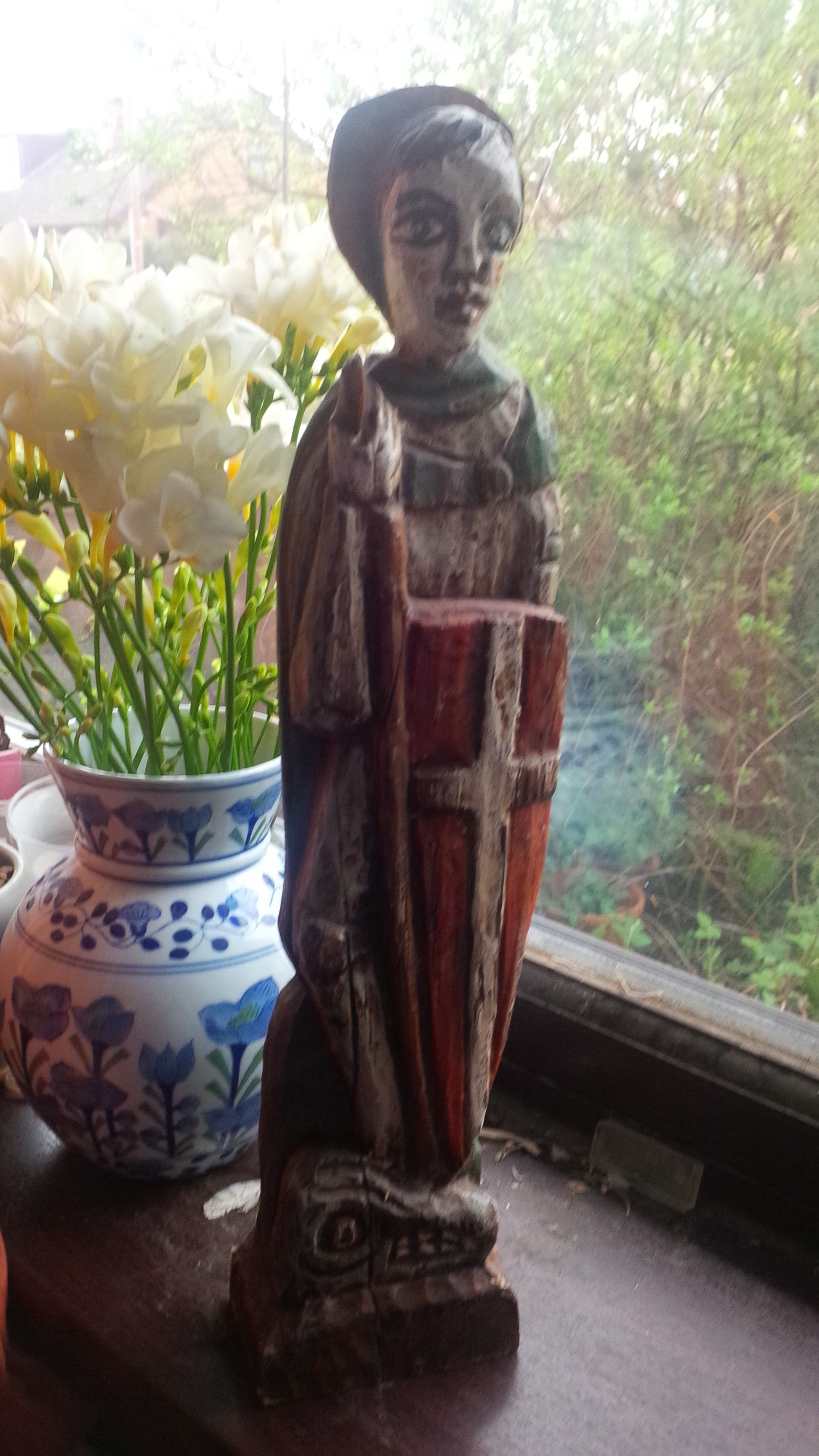
This figure of St George was one of my lovely mum’s favourite finds.

He belongs to an era when Mum had stalls at antique fairs in the South of England.

She had an eye for beautiful things anyway and when she retired, she decided to dabble in actually buying and selling.  My stepdad was generally roped in to lug the special boxes down three flights of stairs – the less special and more commercial boxes were kept in the very cold storage shed by the bins. He didn’t mind too much; he would sit at the back of the stall and read the Sunday papers once everything was set out, maybe strolling off to the nearest pub for a pint of real ale at lunchtime, and coming back to help Mum pack up again.

If he was working, it would fall to me to help.  I liked wandering amongst the other stalls, selling whilst Mum was off having a browse, and I even got into the swing of unwrapping the newspaper from each precious object, displaying it and wrapping it up again at the end of the day.

I learned from Mum. What was good and what was tat. What would sell and what would be endlessly wrapped and re-wrapped.  Different fairs called for different goods depending on the clientele.

I became eagle-eyed for those who came to pilfer; interrupting them with a smile and a question before they had the chance  to tuck the object of desire into a capacious pocket.

Even now special things sing to me from amongst the rubbish.  They may not always be worth much; I probably wouldn’t be any  good on ‘Bargain Hunt’ but as the saying goes – I know what I like.

Some of Mum’s favourites never actually made it onto the stall.  Her St George statue – or Georgie as he became affectionately known, was one of those objects. He stood proudly by the fire in every property Mum lived in: the third floor maisonette I grew up in, the sheltered housing flat she and my stepdad moved into when the stairs became too much, the even more sheltered accommodation just down the road from us that they moved 240 miles to in order to see more of their beloved grandsons, and finally the specially adapted bungalow that enabled Mum to escape from hospital and have an extra eighteen months of freedom.

I was always very fond of Georgie.  He’s a tactile boy with a lovely smile. I’d often sit on the floor next to him whilst watching the TV.  There was always something very reassuring about his solid wooden form.

Not surprisingly, years later when Uni Boy was a toddler, he developed an affection for Georgie too.  We had to watch him closely; the origins of Georgie’s paintwork were unknown and whilst mostly smooth, there were a few hard edges still.  Georgie was one of his first words, which pleased my Mum extremely.

Gap Boy also enjoyed Georgie’s company and at first there were a few tussles regarding ownership but UB moved on to playing chess with Grandma, leaving GB to the less cerebral pleasures of Georgie hugging.

Just like Puff the Magic Dragon, Georgie was abandoned by my boys as they grew older and turned to gameboys and football but he still held pride of place by the fire; a memento of Mum’s antique fair days long after she left us in 2009.

Georgie was the first thing I saw when Hub and I began the long process of clearing out the bungalow after my beloved stepdad died suddenly in 2012.

I brought Georgie home to my own fireplace and he has been there ever since; a symbol of my Mum’s love for her heritage, for beautiful  and unusual things.

My lack of prowess in the field of housework is well-known.  I have had feather dusters but they invariably disintegrate from age rather than use. My mantelpiece is a display area for important but not necessarily priceless objects.

It is Georgie’s special day today so I have dusted him down and elevated him to the windowsill where he can keep company with the freesias and my star-gazing bunny.

Happy St Georgie’s Day Mum.

‘Saturday Night’s Alright (For Fighting)’


soda

It was only ever meant to be a holiday job: a stopgap to earn some money to support her meagre student grant.

In those days it was £80.00 per term which barely covered food: the rent on her tiny bed sit was scraped together by her parents.

Working at a local pub had seemed the ideal solution.  No early starts, plenty of late nights, a social life and more free drinks than she could ever consume.

The downside was the walk up the hill but giggling her way back down again at the end of the night  in a semi-inebriated fashion seemed to take no time at all.

The pub had three bars: the Cocktail bar, the Lounge and the Public.

The Cocktail bar was where the landlord and his cronies hung out.  It was a large room overlooking the pub garden with a very small bar in the corner, dominated by a huge bottle of Bell’s whisky hanging upside-down from a giant optic. The decor was ‘posh’ in the very worst sense. A preponderance of gilt, flock wallpaper and the landlady’s questionable taste in china ornaments.

The Lounge was the domain of the football club members, and the wives who got trotted out on Friday and Saturday nights.  It was a place of huge and complicated drinks rounds, far more cocktail preparation than in the bar next door and the scene of mild disagreements over tactics when the footballers returned from their match at Sunday lunchtime.  There were less frills in this bar and the added disadvantage of access to the toilets meant that however many of those little white blocks you put in the urinal, there was still a pervasive odour of man-wee.

The Public bar housed the pool table and the jukebox.  It was always busy on Friday and Saturday nights, and the scene of regular brawls, dodgy dealings and, as most of the male customers couldn’t be bothered to walk all the way round to the Gents in the Lounge bar, the patch of garden outside the back entrance was pungent, withered and brown from frequent after dark waterings – and worse.

She started work in the Lounge on a Monday night.  Quiet enough to learn the ropes and not disgrace the landlady nor bankrupt the landlord. The other bar staff were initially curious about why this young, well-spoken girl was slumming it behind their bar but the need for money was a common denominator.  It didn’t take long before her usually enumerate mind could add up the prices of the drinks, learn to pour a pint of Guinness proficiently, know when the beer was off (and not when someone was angling for a free pint) and understand the hierarchy of the customers.

She got on well with the landlord and his adult son.  She didn’t tell tales when she saw them topping up the big Bell’s bottle with cheap whisky from the cash and carry; it just made her smile more when one of the imperious old chaps in the cocktail bar ordered ” a G & T for the wife and a Bells for me girly, nothing but the best I say”.

There was always a stream of staff wanting to work the Lounge; the tips were good and it was easy to clean up at the end of the night – apart from the toilets.

Three stalwarts staked their claim over the Cocktail bar so she only ever worked in there if one of them was off sick or on holiday. She hated the pretension and the landlady’s phony friends who bitched behind her back whilst she was ordering their free drinks from the bar.

Few people would have chosen to frequent the Public bar; it was very long and the pillar in the middle of it made it possible for someone with long enough arms to reach over and help themselves to lager. She loved the Public bar though.  Loved the jokes and the bad taste, the cheeky complaints about her choice of music on the jukebox and the fact that here, there was no pretension, just a bunch of  blokes who worked hard at whatever it was made them money and spent it freely at the pub

Going back to a college miles away from home was hard.  Separation from the sea, from her family and from a regular source of money eventually outweighed the company of her fellow students and the enjoyment of learning.  At the end of the second year she decided that she wasn’t going back and the landlord was pleased to take her on permanently.

A month after she should have started back at college, she turned up at the pub for a Saturday morning shift to find a note on the door saying that the landlord was in hospital.  The pub was still open and the most senior of the bar staff was in charge.  Everyone was subdued.

The massive heart attack he suffered killed the landlord that night and the pub shut for the rest of the weekend out of respect.

Things changed.

Regulars who had liked the landlord for his easy-going manner were put off by the snobbish landlady and her delusions of grandeur.  She sat in the Cocktail bar with a couple of hard-core friends who were prepared to put up with her manner if it meant free booze and the odd lunch.

The Lounge and the Public continued to mourn the landlord in their own ways, and by the time Christmas came around, there wasn’t much Yuletide cheer. The landlady refused to fork out for new decorations and as always, the Public bar was left with the tatty, broken and discoloured bits and pieces that weren’t good enough for the other two bars.

New Year’s Eve came and went without the promised extension and it was a sad and sorry crowd that leaned on old, damp bar towels of the deeply depressed Public bar the following night.

A group of men who worked on the oil rigs were home on their holidays: they drank extensively, argued over the pool table and were known for their lack of patience when being served.

She was on her own in the Public bar that night, and although she did her best, people were having to wait for their drinks.

One of the oil rig men couldn’t and wouldn’t wait.  He picked up his neighbour’s half-empty glass and threw the beer down her back whilst she was stood at the till getting change.

She shut the till and gave the change to her customer.

The oil rig man and his mates were laughing.  They were drunk enough to find the whole thing hilarious.

She did not laugh with them.

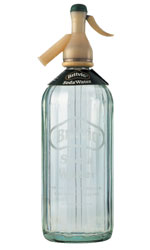
Instead, she picked up a soda syphon from under the bar and emptied it in the faces of the mocking oil men.

It felt good.

In fact, it felt so good that she picked up another soda syphon and did it again, widening her range a little this time.

There was a stunned silence and she took advantage of the shock factor, ran into the kitchen, picked up her bag and fled.

Past the smelly patch of garden, across the busy road, down the hill and up the stairs to her parent’s flat.

She did not stop until the door was safely closed behind her and her mother was helping her out of  her beer stained shirt.

Her mother spoke to the landlord’s son the next morning and said that she wouldn’t be coming back.  He apologised for leaving her alone in the bar but agreed that returning would not be advisable.  He made up her wages – including a bonus for all her hard work – and dropped it off later that day.

A couple of months later, when she was in gainful employment and doing a job that she was more suited to, she bumped into the landlady at the local shops,

She said ‘hello’ courteously and was rewarded with a slap around the face that rattled her teeth and made her cheek sting.

No hard feelings then.


‘Bullies’

Any bullying is bad but using the internet and social media to stalk, insult and mock is the worst. It happened to me today.


Gavin looked up at the clock.  Twenty past two.  Time for a snack.  His parents were sound asleep and would not be disturbed by the sounds of him whipping up a way after midnight snack.  He shut the door from the living room to the stairs, and then quietly closed the kitchen door so that no cooking smells would permeate the upper floor.  He had been caught out like that before.  Despite the meticulous washing up and putting away of all the cutlery, crockery and kitchen utensils, his mother’s face the next morning at a breakfast of rubbery scrambled egg and burnt toast, had said it all.

It was the silent reproach that hurt him the worst.  He could parry the acid comments as they fell from her disappointed lips, but the look on her face, the look that told him how ungrateful he was for supplementing the food his mother so carefully ruined for him, it cut him to the quick and made him even more determined to hide his secret excesses.

There was no such reproach from his father however; locked inside the fantasy world that had descended long before the official diagnosis of Alzheimer’s Disease had been made, his father smiled through every day in a place where he shovelled in the burnt offerings as if they were ambrosia from the gods.  A place where the TV held new delights every day and the operation of the remote control was a thing of wonder.  Answering the telephone was slightly more problematic; Gavin’s mother wasn’t always quick enough to seize the handset before his father’s querulous voice could begin interrogating whichever hapless PPI salesperson or accident insurance company had called.  His mother dealt with all callers with a briskness at odds with her age and disabilities; cutting through the call centre scripts and dispatching the recorded messages with expediency.  She was a formidable woman.

Hatches thoroughly battened down now, Gavin began assembling the foods for his favourite late night meal; chicken breast, salsa, onions, peppers, a soft tortilla or two, sour cream, grated cheese and oh, deep joy, guacamole.  He was the fajita king!

Ready to rustle up his guilty pleasure before creeping back to his internet stalking on the laptop, he could feel his mouth fill with saliva that wasn’t just due to thesmell of the food. He would savour every mouthful, washed down by an illicit bottle of fizzy drink that he had smuggled home in his briefcase with the fajita ingredients.  His mother didn’t approve of fizzy drinks having seen a programme where they left pennies in a glass of fizzy overnight and produced a batch of shiny metal in the morning.

“Just think!” she said.  “Just think what that stuff is doing to your stomach!  I didn’t go through fifty-three hours of agonising childbirth to have your stomach ruined by fizzy drinks!  Are you sure that you aren’t drinking this rubbish at work?  I can always ask your secretary!”

Gavin had briefed his secretary well.  Anna was a good girl.  Not bright but bright enough to understand that when Gavin’s mother phoned she was to use the list he had made for her when replying to questions and not to deviate from the set topics.  Yes, Gavin was in a meeting. No, she wouldn’t forget to ask him to call his mother back, she was writing a note for him at the moment and would pop it on his desk for his return.  Yes, she had seen Gavin eat the sandwiches his mother had prepared for him and she had only made him two cups of coffee this morning using the decaffeinated instant brand that his mother used at home.  Gavin had made it quite clear to Anna what would happen if she revealed his mother’s demanding ways to her colleagues and as a consequence, she gave a tight-lipped smile when asked about him and would only comment that he was very easy to work for.

Licking the sour cream from around his lips, Gavin searched hungrily for any mention of the woman he had set out to torment.  He hadn’t actually followed her online yet, that would come later.  A nice piece of intimidation that would inevitably end up with his being blocked, so he had to work hard to rummage around in her brief and personal musings first.  Music; she obviously liked music, and comedians, actors, journalists and writers.  He sighed as he chewed on a particularly tasty piece of chicken; this account was not proving as fruitful as he had hoped.  . Damn!

Fajita finished, he left the laptop on whilst he washed and cleaned the surfaces; removing every trace of his transgression, then moving silently out of the back door to hide the last pieces of evidence in their next door neighbour’s bin.  He had been doing this ever since his mother, wielding her stick, had gleefully produced the fruits of her wheelie bin grubbing; a bag containing the remnants of a KFC meal that he had consumed on the way home and needed to get out of the car because he was taking her out shopping the next day.

The mileage his mother got out of this heinous crime haunted him to the extent that his fast food intake was severely affected for over a month and his digestive system suffered from the penance of burnt offerings.  He had grown wise now and all evidence was deposited in next door’s rubbish or in a bin far, far from home where his mother and her stick could never venture.

Putting his briefcase up on the table; Gavin extracted the file that contained everything on the woman who had been his obsession for the past six days.  He would see her crumble before him; begging for mercy with no sign of the cool and almost amused tone he had heard when he had spoken to her on the phone.  She was not going to be as easy to deal with as some of his other victims.  No matter.  He loved a challenge.

He skim read the file again.  Her qualifications annoyed him too.  She had far too many, and she had a long and unblemished service record.

The profile picture had been changed recently to a selfie she had taken.  He stroked the long hair with his finger; traced the shape of her large blue eyes hiding behind the glasses.   He knew her; knew so much about her now that he was sure that  the means of her downfall lay in his hands.  This was his skill, the reason for his meteoric rise from a humble clerical officer to the head of his department.   He had worked for six different employers in order to achieve this however and whilst he had left damage and resentment in his wake, Gavin Slime was headed for the top of his profession and was a man who was head-hunted for his ruthlessness and determination.

He looked up at the clock.  It was twenty past three and time he went to bed.  With a sinister smile on his thin lips he hit the follow button knowing that an email would be waiting in her inbox when she got up the next morning. An email announcing that he was following her on Twitter.  His profile picture, in an attempt at humour, showed him eating a giant fajita with only his eyes and horn-rimmed glasses on show as a clue to the man within.  He closed down the laptop and put it away so that the kitchen table would be pristine for his mother when she descended to her kitchen to prepare his sandwiches four hours later.

Following the routine he carried out every night, Gavin checked the doors and windows on the ground floor of the house.  He checked every inch of the scoured worktops, cooker and table, even peering short-sightedly down the plug hole of the sink in case any fajita detritus remained to betray him to his mother.  Nothing.  He put his laptop bag and briefcase out into the hall and under the table where no one would trip over them, then climbed the stairs  before he turned the corner and went into his immaculately tidy bedroom.

It was a room that was frightening in its sterility.  The predominance of white prevented any undetected sullying of his domain; duvet cover, sheets and pillow-slips were pristine, starched and laundered to his specific requirements rather than thrown in the washing machine by his father’s carer June.  The sterile white vertical blinds gave the room an additionally medical feel that was enhanced by the uncluttered white bedside cabinet, part of a set from of white Swedish furniture that included a wardrobe, chest of drawers and two chests.  One of these chests held fresh bed linen, still in its laundry packing and ready for Gavin to put on the bed once the sheets no longer felt clean and new.  The other chest was closed with an iron hasp and weighty padlock to which only Gavin had the key. It contained secrets; the sort of secrets people cringe from, the sort of secrets that destroy lives and that would put Gavin in a position where at least a dozen people would pay to have him quietly removed from the earth.

They weren’t just other people’s secrets however.  Gavin kept his own secrets in the chest, secrets that made him blush and rush to lock his bedroom door, secrets that lit up his pale grey eyes and made his pulse race. They were secrets that no one must ever know and the mere thought of anyone else discovering them gave Gavin chills of excitement and fear.

He got changed for bed into his crisp pale blue cotton pyjamas.  He never wore the same pair for more than two days and then they too went off to the laundry.  He slipped into the small en-suite that he had paid to have built into his room.  The main bathroom was filled with the equipment and medication of two people who were dying by degrees and he wanted no part of it, no unnecessary clutter in his life. Not anymore.  After brushing his teeth with the state of the art electric toothbrush, Gavin Slime went back into his room, placed his glasses neatly on the bedside table and slid between his glacial sheets, a sinister smile on his face as he thought of the woman’s reaction when she got up and saw the email sent on his behalf.